Why Gentle Movement Is the Missing Piece for Tight Hips and Glutes
If you have spent years trying to fix tight hips with aggressive stretching or heavy glute work, and still wake up stiff every morning, this article is for you. The best exercise for hips and glutes is not always the one that makes you feel the burn or the deepest stretch. Sometimes it is the one that feels almost too easy - a slow, breath-synced movement that teaches your nervous system to release a protective grip it has been holding for years.
Gentle movement for hips and glutes is not a watered-down version of stretching. It is a different category entirely. It sits between static stretching and strength training, using micro-movements and mindful repetition to reset the nervous system and restore pain-free range of motion. This approach is especially valuable if you deal with arthritis, chronic pain, or are recovering from an injury.
In this guide, I will walk you through a complete somatic flow sequence for hips and glutes, explain why this approach works when others have not, and give you a practical framework for building it into your daily routine.
The Somatic Flow Framework: Less Is More
Somatic movement comes from the Greek word "soma," meaning "the living body." The core idea is that many of our movement problems are not structural - they are neurological. Your muscles are not actually short or weak. They are being held in a state of chronic contraction by your nervous system, often as a protective response to stress, injury, or prolonged sitting.
Most people do not realize this. They assume that tight hips mean they need to stretch more or strengthen the glutes more. But if the problem is a nervous system protection pattern, neither aggressive stretching nor heavy loading will solve it. In fact, both can reinforce the problem. When you push hard into a stretch, your nervous system perceives it as a threat and tightens the muscle further to protect the joint. When you load the glutes heavily, the same thing can happen if the underlying tension pattern is still in place.
The somatic approach flips this completely. Instead of forcing the body to change, you invite it to change. You move slowly, breathe deeply, and stay well within your comfortable range of motion. You repeat the movement enough times that the nervous system starts to register that this range is safe. Over time, the protective grip loosens.
This is why the question "What is the number one exercise for hips?" is somewhat misleading. The best exercise depends on what your body needs at a given moment. For someone with acute tightness and pain, the number one exercise is the one that does not provoke a protective response. For most people, that is a simple pelvic tilt or leg slide - not a pigeon pose or a barbell hip thrust.
The Three Principles of Somatic Flow
There are three principles that separate somatic flow from regular stretching or mobility work. If you miss any of these, you will default back to the same patterns that have not been working for you.
- Slow. Each movement should take 10 to 15 seconds to complete in each direction. This is much slower than you think. The slow pace is what allows your nervous system to register the movement as safe.
- Breath-synced. Inhale as you move into the position, exhale as you release. The exhale is the key to nervous system relaxation. If you find yourself holding your breath, you are going too fast or moving too far.
- Pain-free. You should never feel a sharp or intense stretch. A mild sensation of tension is fine, but if it feels like a "pull" or a "burn," you have gone too far. The goal is to stay in a range where the nervous system feels calm, not threatened.
When I first tried somatic movement for my own hip tension, I made the mistake of treating it like a stretch. I lay on the floor, moved my leg slowly, and kept waiting for that familiar pull that I associated with a productive session. It never came. And for weeks, I thought I was doing something wrong. It was not until I stopped looking for the stretch sensation and instead focused on the quality of the movement - the smoothness, the breath, the ease - that my hips actually started to unlock.
What the Research Suggests About Slow, Mindful Movement
The idea that slow, gentle movement can reduce pain and improve mobility is not just anecdotal. Research on mind-body practices like Qigong and Feldenkrais - both of which share principles with somatic movement - has shown measurable benefits for chronic pain and mobility. A systematic review published in the Journal of Pain Research found that mind-body movement interventions consistently reduced pain intensity and improved physical function in adults with chronic musculoskeletal pain.
The mechanism is not fully understood, but the leading theory involves the nervous system's ability to update its predictions about what is safe. When you repeatedly move a joint through a comfortable range without pain, your brain gradually updates its internal model. It stops predicting that movement will hurt, and it allows the muscles to relax accordingly. This is why the pace and the absence of pain matter more than the range of motion.
The Complete Somatic Flow Sequence for Hips and Glutes
Below is the sequence I use with clients and personally. It takes about 15 to 20 minutes to complete in full, but even 5 minutes of any single movement can be beneficial. You will need a comfortable surface - a yoga mat, a rug, or even a firm bed. For the seated movements, a chair works fine.
This sequence answers the question "What are some gentle hip exercises?" directly. These are the exercises I recommend when someone needs to loosen up tight hips and glutes but cannot tolerate aggressive stretching or loading.
Movement 1: Supine Pelvic Tilts
Lie on your back with your knees bent and feet flat on the floor, hip-width apart. Let your arms rest at your sides. This is your starting position.
On an inhale, gently tilt your pelvis toward your heels, so your lower back presses lightly into the floor. On an exhale, allow the pelvis to return to neutral, and then tilt it the other way, creating a small arch in your lower back. Move slowly, taking about 5 seconds in each direction.
Repeat this 10 to 15 times. The range of motion is small - maybe 2 to 3 inches of travel. The point is not to move far but to move smoothly. You are looking for a sense of fluidity in the lower back and pelvis, not a stretch.
What can go wrong: People often rush this movement, turning it into a fast rocking motion. Slow it down. If you feel any pinching in the lower back, reduce the range of motion until the pinching disappears.
Movement 2: Leg Slides
Still on your back, with knees bent and feet flat, inhale and slowly slide your right heel out along the floor until your leg is almost straight. Exhale and slide it back to the starting position. Alternate legs, doing 8 to 10 slides on each side.
The key here is to keep the movement controlled. Do not let the leg just fall open or the knee rotate excessively. You are looking for a smooth, even glide. If your lower back arches as the leg extends, you are sliding too far. Shorten the range until the back stays neutral.
Leg slides are one of the most underrated gentle movements for hips and glutes. They work the hip flexors, the glutes, and the deep core stabilizers without any loading or stretching. I have used them with clients who were weeks post-injury and could not tolerate anything else.
Movement 3: 90/90 Hip Transitions
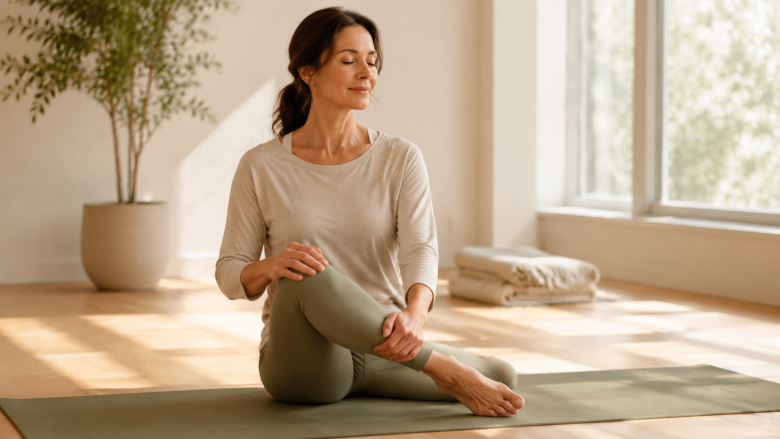
This is a seated movement. Sit on the floor with your legs bent at 90 degrees in front of you - one leg forward with the knee pointing up, the other leg out to the side with the knee pointing sideways. This is the 90/90 position.
On an inhale, gently shift your weight forward and lift your hips slightly. On an exhale, rotate your torso and legs to transition to the other side, so the leg that was forward is now out to the side, and vice versa. Move slowly, taking 10 to 15 seconds for the full transition.
If this is too challenging, you can do a modified version from a chair. Sit on the edge of a chair with both feet flat. Cross one ankle over the opposite knee, and gently lean forward with a flat back. Hold for a breath or two, then switch sides.
The 90/90 transition is what I recommend when someone asks me how to loosen up tight hips and glutes without kneeling or lying down. It is accessible, gentle, and works the hips through multiple planes of motion.
Movement 4: Side-Lying Hip Circles
Lie on your side with your legs stacked and your head resting on your lower arm. Bend your knees slightly to about 45 degrees. Keep your feet together and your knees together.
On an inhale, slowly open your top knee like a clamshell, keeping your feet together. On an exhale, close it back down. Do this 10 times slowly. Then, switch sides.
This movement is often called a "clam" in physical therapy. It targets the gluteus medius, which is one of the primary stabilizers of the hip. The gentle version I am describing keeps the range small and the pace slow, which makes it accessible even for people with hip osteoarthritis.
When I first started doing these, I made the mistake of trying to open my knee as far as possible, thinking more range meant more benefit. But the gluteus medius works best in its mid-range. The small, controlled movement is what actually engages the muscle and teaches it to fire correctly.
Movement 5: Seated Hip Sway
Sit comfortably in a chair with your feet flat on the floor, hip-width apart. Place your hands on your thighs. On an inhale, gently shift your weight to the right, so your right glute presses into the chair and your left glute lifts slightly. On an exhale, return to center. Then shift to the left.
Do 10 to 15 repetitions on each side. This movement looks almost ridiculously simple, but it is remarkably effective for releasing tension in the glutes and the lumbar spine. It is also the most accessible movement in this sequence - you can do it at your desk, in a waiting room, or even in your car at a red light.
The hip sway is the closest thing I have found to a "number one exercise" for hips and glutes when the goal is purely to release tension. It requires no equipment, no floor, and no special clothing. And because the range of motion is so small, there is virtually no risk of overdoing it.
As we covered in our guide to gentle yoga poses for tension release, the principles of slow, breath-synced movement apply across modalities. The seated hip sway is a great bridge between yoga and somatic work because it uses the same mindful approach in a chair-based format.
What Goes Wrong: Mistakes Even Experienced Movers Make
Even people who have been practicing yoga or Pilates for years often make these mistakes when they first try somatic flow. Here is what to watch out for.
Mistake 1: Treating It Like a Stretch
The most common mistake is approaching somatic movement with the same mindset as stretching. You are looking for the "pull" or the "burn," and when it does not come, you push further until it does. This completely defeats the purpose. If you feel a strong stretch, your nervous system is already in protective mode. Back off until the sensation is mild and tolerable.
Mistake 2: Rushing the Breath
Your breath is the primary tool for nervous system regulation. If you rush your breathing or hold your breath, you are essentially telling your body that this is stressful. The exhale is especially important - it activates the parasympathetic nervous system, which is the "rest and digest" branch. Make each exhale at least as long as your inhale, and try to make it slightly longer.
Mistake 3: Expecting Immediate Results
Somatic movement works differently from stretching or strengthening. A stretch can give you a temporary increase in range of motion within minutes. Somatic movement is slower - it is rewiring the nervous system, and that takes repetition over days and weeks. Most people notice the first real shift after 3 to 5 sessions. If you do not feel dramatically different after one session, that is normal.
Mistake 4: Doing Too Much
Because somatic movement feels so gentle, people often assume they should do more of it. They extend the session to 45 minutes or an hour, or they repeat the sequence three times in a row. This is counterproductive. The nervous system tires of the repetition and stops registering the movement as novel and safe. Fifteen to twenty minutes is the sweet spot. More is not better.
When to Choose Somatic Flow vs. Stretching vs. Strength Training
I want to be clear about one thing: I am not saying somatic flow should replace all other forms of movement. It fills a specific gap. Here is a practical framework for deciding what you need.
| Goal or Situation | Best Approach | Why |
|---|---|---|
| Chronic hip tightness with no clear cause | Somatic flow | Addresses the nervous system pattern, not just the muscle |
| Acute pain or post-injury recovery | Somatic flow | Pain-free, low-risk, does not provoke protective responses |
| Specific range-of-motion deficit, no pain | Static stretching | Ok when nervous system is already calm and you need to lengthen tissue |
| Building glute strength for performance | Strength training | Loading is necessary for hypertrophy and force production |
| Desk worker with stiff hips from sitting | Somatic flow first, then strength | Release the protective pattern, then build strength in the new range |
In practice, most people benefit from a combination. For example, you might do 10 minutes of somatic flow in the morning to release overnight stiffness, and then later in the day do your normal strength workout. The somatic work primes the nervous system, making the strength work more effective and safer.
The World Health Organization recommends that adults do at least 150 minutes of moderate-intensity physical activity per week. Somatic flow can count toward this, especially for people who cannot tolerate higher-intensity exercise. But it is also worth noting that somatic flow is not a substitute for cardiovascular exercise or strength training. It is a complement.
Adapting Somatic Flow for Specific Conditions
One of the strengths of this approach is how easily it adapts to different situations. Here is how to modify the sequence for common conditions.
For Desk Workers
If you sit for 8 or more hours a day, your hip flexors are in a shortened position for extended periods. The most useful movements for you are the seated hip sway and the 90/90 chair modification. Do these every 2 hours, even if it is just for 60 seconds. The goal is to interrupt the prolonged sitting pattern before it becomes a protected resting state.
For Hip Osteoarthritis
The National Institute on Aging emphasizes the importance of gentle, flexible movement for older adults with joint conditions. For hip osteoarthritis, focus on the supine pelvic tilts and leg slides. Keep the range of motion very small - just enough to feel a subtle shift in the joint, not a stretch. Stop immediately if you feel sharp or catching pain. These movements are not meant to treat the arthritis itself, but to keep the surrounding tissues from tightening further.
For Sciatica or Nerve Pain
If you have nerve-related pain radiating down your leg, movements that involve spinal flexion - like the 90/90 transition - may aggravate it. Stick to the supine movements and the side-lying hip circles. Move even more slowly than usual, and if any movement reproduces the nerve symptoms, skip it entirely. Nerve pain is a signal, not something to push through.
For Post-Injury Recovery
After a hip or glute injury, the nervous system goes into high alert. The muscles around the joint will guard excessively, even after the tissue has healed. This is where somatic flow shines. Start with 3 to 5 minutes of supine pelvic tilts and leg slides, once or twice a day. The key is consistency over intensity. Over 2 to 3 weeks, you will notice the guarding response gradually decrease.
How to Build a Sustainable Practice
The biggest barrier to any movement practice is consistency. Here is how to make somatic flow stick.
Start with 5 Minutes
Do not try to do the full 20-minute sequence on day one. Start with 5 minutes - just the pelvic tilts and leg slides. Do this every day for a week. Then add the 90/90 transitions. The following week, add the side-lying circles and the seated hip sway.
This progressive approach does two things. It gives your nervous system time to adapt, and it prevents the "all or nothing" mindset that leads people to quit after a few days of overdoing it.
Anchor It to an Existing Habit
The most reliable way to build a new habit is to attach it to something you already do. For example, do your somatic flow sequence right after your morning shower, or before your evening meal. The anchor does not matter - what matters is that it is consistent.
Listen to Your Body, Not the Clock
Some days, 5 minutes will feel like enough. Other days, you might want to do the full 20 minutes. Let your body decide. If you are moving through a painful flare-up, shorten the session and reduce the range of motion. If you feel good, extend it slightly. The practice should never feel like a chore.
Track the Subtle Changes
Because somatic movement is so gentle, the changes can be easy to miss. Keep a simple journal. Each day, write down one thing: how your hips felt when you woke up, how easy it was to get out of a chair, whether you noticed any clicking or catching. After two weeks, look back at what you wrote. You will likely see a pattern of improvement that you would not have noticed day-to-day.
The Bottom Line: What Gentle Movement Can and Can't Do
Gentle movement for hips and glutes is not a miracle cure. It will not give you a bigger glute muscle, and it will not fix a structural joint issue like severe hip osteoarthritis or a labral tear. If you have a diagnosed structural problem, you need to work with a physical therapist or orthopedic specialist.
What gentle movement can do is profound in its own way. It can teach your nervous system to stop guarding your hips and glutes. It can reduce chronic tension that has resisted stretching and strengthening for years. It can make everyday movements - standing up, walking, getting in and out of a car - feel easier and less painful. And it can do all of this without ever pushing you into pain.
The best exercise for hips and glutes is the one you can do consistently, without pain, and with full attention. For many people, that is not a deep stretch or a heavy lift. It is a slow, breath-synced, gentle movement that respects what the body is ready to do today. That is the essence of somatic flow.
If you have been struggling with tight hips and glutes and nothing has worked, try this sequence for two weeks. Five to fifteen minutes a day. Slow, breath-synced, pain-free. You might be surprised at what your body can release when you stop trying to force it.