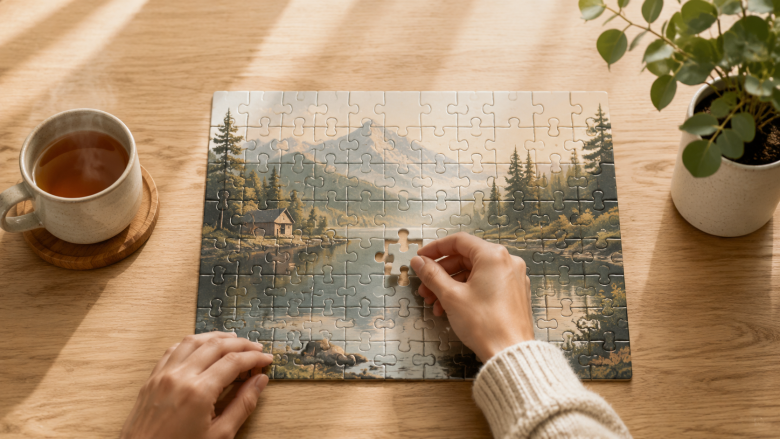
Calm Your Mind with a Puzzle: The Practical Guide
Yes, jigsaw puzzles can genuinely calm your mind - but only if you approach them with intention. Plunking down a 2000-piece puzzle when your anxiety is at its peak will backfire. The key is to treat puzzling as a structured exercise, not a distraction. You need the right environment, the right puzzle size, and a specific technique to shift your brain into a relaxed state. This guide shows you exactly how to do that, based on my years of using puzzles to manage racing thoughts and daily stress.
I have been an avid puzzler for over a decade. I have burned through everything from 250-piece family puzzles to a brutal 5000-piece landscape that took me three months. Along the way, I have discovered what works, what fails, and how to turn a simple hobby into a reliable anxiety-management tool. This is not a theory piece. It is a field guide.
Why Puzzling Works: The Neuroscience of Calm
Before you pick up a piece, understand why this works. When you solve a jigsaw puzzle, your brain enters a state of focused attention that closely resembles mindfulness meditation. You are not thinking about the past or future; you are scanning for shapes, colors, and patterns. This is what psychologists call flow - the state where you are so completely absorbed that time and self-consciousness fade away.
But the mechanism goes deeper. Your brain loves order. Completing a puzzle gives you a sense of control and accomplishment, which directly counteracts the chaos that anxiety thrives on. A 2018 study from the University of Ulm found that jigsaw puzzling activates multiple cognitive functions, including visual-spatial reasoning and working memory. While that study focused on cognitive health, the emotional benefit is just as real. The repetitive picking and placing of pieces triggers a calming, rhythmic response - similar to knitting or coloring.
Is doing a puzzle good for your brain? Absolutely. It keeps your mind sharp, improves short-term memory, and promotes neural plasticity. But for our purposes, the most valuable effect is the immediate lowering of stress hormones. When you focus on a puzzle, your amygdala - the brain's fear center - gets a break from constant alarm. The key is to keep the challenge manageable so you stay in that flow channel, not in the frustrated or bored zones.
The core insight: Puzzling calms your mind when it offers the right level of challenge - too hard causes stress, too easy causes boredom. The art is matching the puzzle to your current anxiety level.
The Puzzle Prescription: A 3-Step Protocol
This is the framework that top Google results are missing. They tell you puzzling helps, but not how to do it effectively. I call it the Puzzle Prescription. It has three steps: prepare your environment, select the right puzzle, and execute the piece-and-breathe technique. Follow this every time you sit down, and you will notice a measurable difference in your stress levels within 15 minutes.
Step 1: Environment Setup
You cannot calm a racing mind if your surroundings are chaotic. Before you open the box, set up a space that supports relaxation. I learned this the hard way: I once tried to puzzle at my desk, which was cluttered with unpaid bills and a blinking cursor on my laptop. I lasted four minutes before the anxiety got worse. Now, I have a dedicated corner with a soft lamp, a comfortable chair, and a clear table.
Start with lighting. Warm, low-wattage bulbs work best. Bright white daylight LEDs mimic a work environment and keep your brain in alert mode. A 40-watt incandescent or a warm LED strip around the puzzle area creates a cozy, cave-like feel. If you can, place a small lamp directly over the puzzle table, but keep the overall room dim. This reduces visual noise and helps your pupils dilate slightly, which signals relaxation.
Next, control sound. Silence is fine for some, but most people benefit from white noise or ambient music. I recommend a low-volume playlist of instrumental lo-fi or nature sounds. The reason is that unpredictable sounds - like a door slamming or a conversation across the room - re-trigger your stress response. Steady background noise masks those spikes. For more on how to use nature sounds for calm, see our guide on connecting with nature.
Finally, set your posture. You should sit with your feet flat on the floor, lower back supported, and shoulders relaxed. Slouching or leaning over the table for too long creates neck tension, which your brain interprets as a physical threat. Put the puzzle on a portable board or a tilted surface if you have one. A vertical easel that holds the puzzle at eye level is ideal because it prevents forward-head posture and lets you breathe fully. If you do not have one, propping the board against a stack of books works fine.
Step 2: Choose Your Puzzle Based on Your Stress Level
This is the step where most people go wrong. They buy a 2000-piece puzzle because they think it will be more absorbing, but when they are already anxious, that sheer size becomes overwhelming. The rule is simple: the higher your anxiety, the smaller the puzzle. You need the instant reward of completing pieces to keep your mood up.
Here is a decision matrix I have refined over years of practice:
- Severe acute anxiety (panic attack, high tension): Choose 100-250 pieces. A simple image with large color blocks. You need almost immediate success. This is not a challenge; it is a soothing activity. Think of a children's puzzle but not too childish.
- Moderate anxiety (racing thoughts, irritability): Choose 300-500 pieces. This is the sweet spot for most people. Enough complexity to hold attention, but you can finish a section in one sitting.
- Mild stress or general overthinking: Choose 750-1000 pieces. This offers a deeper immersion. You will likely spread it over multiple days, but the act of returning to the same puzzle becomes a ritual.
- Calm and balanced: Choose 1500-3000 pieces for a long-term project. But only if you already feel grounded. If you are using a puzzle to chase calm, do not start here.
What about digital puzzles? They have their place - especially if you travel or have no table space - but they are less effective for calming. The tactile sensation of real pieces, the feel of the cardboard, and the physical act of snapping pieces together are all part of the soothing loop. A screen keeps your eyes strained and your brain in a scanning mode. For anxiety relief, physical puzzles are superior. That said, if you are stuck in a waiting room or on a long flight, a digital puzzle on a tablet is better than doom-scrolling social media. Just keep the difficulty low.
What game calms anxiety? Jigsaw puzzles are the primary answer, but other calm-inducing games include adult coloring books, Sudoku with pencil and paper, and simple sorting games like Tetris in slow mode. However, none of them provide the combination of visual pattern recognition, tactile feedback, and sequential ordering that a jigsaw does. Sudoku can be too logic-pressured for some; puzzles are more forgiving because you can always see the next piece's fit.
Step 3: The Piece-and-Breathe Technique
This is the heart of the Puzzle Prescription. You are not just putting pieces together; you are using the puzzle as a rhythmic anchor for your breath and attention. I developed this technique after reading about square-wave breathing and realizing that the natural cadence of puzzling - pick, scan, place - could be synced to inhalation and exhalation.
Here is how it works:
- Sit with your back straight but not rigid.
- When you pick up a piece, inhale slowly through your nose for a count of 4.
- As you scan the space and search for where it goes, hold your breath for a count of 4 (or just let it naturally settle).
- When you place the piece into its spot, exhale slowly through your mouth for a count of 6.
- Pause for 2 counts before picking the next piece.
This is not forced or rigid. You do not need to count perfectly. The point is to link the physical action to a slow exhale. The extended exhale stimulates the vagus nerve, which activates the parasympathetic nervous system - the "rest and digest" response. You are literally tricking your brain into calming down. For more on the science of breathing, see our detailed guide on deep breathing.
Most people do not realize that the brain is hardwired to relax when you exhale longer than you inhale. That is why sighing feels so good. By forcing a slow exhale on each successful placement, you are building a positive feedback loop: piece fits, you breathe out, your body relaxes, and your confidence grows.
If your mind wanders back to a stressful thought, do not fight it. Gently acknowledge it, then redirect your attention to the next piece. This is the same skill as mindfulness meditation. Over time, you will get better at noticing the wander and pulling back - and that skill transfers to your daily life.
When Puzzling Goes Wrong: Frustration and How to Avoid It
No tool is perfect. I have had many sessions where I ended up more agitated than when I started. The most common culprit is choosing a puzzle that is too difficult for the given stress level. You know that feeling: you have been searching for a specific piece for twenty minutes, the sky does not look like the picture, and you start questioning your own sanity. That is the opposite of calm.
Here is what to do when frustration builds:
- Stop immediately. Set a countdown timer when you start - say 30 minutes. When it rings, stand up, stretch, and drink water. Do not push through.
- If you are stuck on a particular section, switch to the edge pieces or sort pieces by color. Doing something mindless and mechanical restores the rhythmic feeling.
- Step back from the table. Literally look at the puzzle from a few feet away. This often helps you spot misfits and gives your brain a break from close-focus.
- If you have been at it for more than 45 minutes, stop for the day. Your brain needs a break. Puzzling should feel like a gentle retreat, not a deadline.
The thing nobody tells you about puzzling is how often you will be tempted to force a piece that does not fit. That urge to jam a piece where it is almost right is a mirror of other compulsions in your life. Notice it, laugh at it, and move on. This is a workshop for your patience.
The Deeper Benefit: Cognitive Reframing While You Piece
The best part about the Puzzle Prescription is that it allows you to do something beyond distraction. While you are sorting pieces, you can practice reframing your anxious thoughts. This is not about positive thinking. It is about changing the narrative in your head, one smooth piece at a time.
Here is a simple reframing exercise: every time you find a piece that fits, silently say to yourself, "This fits. There is a place for everything." When you make a mistake, say, "That did not fit. I can try another way." These may sound trite, but they reprogram your internal dialogue from catastrophic phrases like "nothing is going right" to the more neutral and accurate "I am making progress, and mistakes are just part of the process."
If you have a specific worry, you can use the puzzle as a metaphor. Every piece in the box is like a component of your problem. Some pieces you use immediately, some you sort for later, and a few are stubborn and require patience. You do not have to see the whole picture at once; you just focus on one connection. As you complete the puzzle, you are proving to yourself that even a chaotic-looking box can become a coherent, beautiful whole. This is a powerful message for an anxious mind.
You can also combine puzzling with positive affirmations. Before you begin, set an intention like "I am calm and capable" or "I allow myself to focus." Repeat it silently as you pick up each piece. For more on this, check out our article on morning affirmations, which you can adapt for a puzzling session.
A Real-World Example: My Own 500-Piece Turning Point
I would not have created this framework if I had not failed first. Two years ago, I was in the middle of a major work deadline. I felt a constant low-grade panic. I decided to start a 2000-piece puzzle of a dense forest scene, thinking that the complexity would distract me. It did the opposite. After an hour, I had sorted edges but could not find the corner pieces. I started sweating, my jaw clenched, and I almost threw the box. That night I had a terrible sleep.
The next day, a friend recommended a 500-piece puzzle of a sunset over a calm ocean. The pieces were large, the color gradients were broad, and the sky was a solid orange. I set up a small table by my window and followed steps I had not yet formalized. I chose a 500-piece because I was moderately anxious. I played soft lo-fi. I picked up a piece, inhaled, searched, placed, exhaled. Within twenty minutes, I noticed my shoulders had dropped. I had finished the sky in one session, and the sense of accomplishment was tangible.
That experience taught me the importance of matching the puzzle to your stress level. Since then, I have applied the same principles hundreds of times. It works consistently when I follow the steps honestly. When I cheat - like using a 1500-piece puzzle on an anxious day - I pay for it with frustration.
Integrating Puzzling into Your Daily Routine
To get the most from the Puzzle Prescription, make it a habit, not a one-off escape. I recommend scheduling a puzzling session at the same time each day, even if it is just 15 minutes. Morning sessions can set a calm tone. Evening sessions can help you wind down and break the cycle of "revenge bedtime procrastination" where you scroll on your phone because you are too wired to sleep.
Aim for a specific ratio: for every hour of high-stress work, steal 10 minutes for a puzzle. This is like taking a mini-vacation for your brain. If you have a puzzle table that stays out permanently, you can piece together a few minutes whenever you need a reset. This is why I love having a dedicated puzzle board - I never have to clear it away.
You can also integrate puzzling into other calming activities. For example, if you practice a breathing exercise from our deep breathing guide, you can do it at the puzzle table. Or you can pair your puzzling with nature sounds, as mentioned earlier. And if you are at work, setting up a small puzzle on a side desk can be a better break than checking social media. See our tips on making your desk area more relaxing for more ideas.
Be careful not to turn puzzling into a chore. The moment you feel obligated to finish a puzzle, the stress returns. I have abandoned puzzles at 90% completion and that is okay. The process is the therapy, not the finished board. Frame it as "I get to puzzle" rather than "I should puzzle."
Not a Silver Bullet, But a Reliable Tool
I want to be honest: puzzling is not a cure for clinical anxiety or depression. If you are experiencing severe symptoms, please seek professional help. But for everyday stress, racing thoughts, and the general noise of modern life, a puzzle is one of the most accessible, low-cost, non-pharmaceutical tools you can have. It does not require an app subscription, a gym membership, or a prescription. It just requires a flat surface, a box of pieces, and the willingness to breathe.
The Puzzle Prescription is not a rigid dogma. You might find that a different puzzle size or a different breathing rhythm works better for you. That is perfect. The core principle is to be intentional: choose your puzzle based on how you are feeling, prepare your environment, and let each piece placement be a small victory that guides your breath and focus. Over time, you will develop a conditioned response - your body will relax the moment you sit down with a puzzle.
Next time you feel anxious, try this. Do not reach for your phone. Do not pour a glass of wine. Pick up a puzzle that you know you can handle, set a timer for 30 minutes, and let the piece-and-breathe technique do its work. The calm you are looking for is not outside yourself; it is hidden among the pieces, waiting for you to find it.