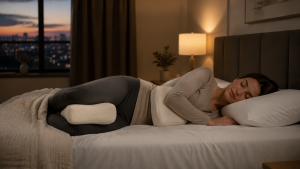
The 3 AM Terror: When Silence Becomes the Enemy
The first time I heard my own tinnitus at 3 AM, I thought something was wrong with my house. A high-pitched electrical whine that seemed to come from the walls. When I realized it was inside my head, my heart started pounding. And in that instant, the sound got louder.
That is the tinnitus anxiety loop in action. The fear makes your brain hyper-vigilant, and hyper-vigilance makes the sound seem louder. Then you can't sleep, which makes you more anxious, which makes the tinnitus worse. It is a vicious cycle that no amount of white noise alone can break.
The good news? You can break it. The answer isn't to make the sound go away. It is to change how your brain responds to it. This article will show you exactly how to do that, using the same evidence-based approaches that audiologists and sleep specialists use with their patients.
Forget the generic advice about cutting caffeine and taking warm baths. You already know that. What you need is a systematic approach to stop the fear response, retrain your brain, and rebuild a healthy sleep structure. That is what we are going to do here.
Why Tinnitus Attacks You at Night (And It's Not What You Think)
Most people assume nighttime is worse because it's quiet. That is only half the story. In a 2022 study published in Frontiers in Neurology, researchers found that the perceived loudness of tinnitus at night is strongly correlated with anxiety and depression scores, not just the ambient noise level.
The real problem is this: during the day, your brain is busy. It's processing conversations, traffic, work tasks, and the thousand small distractions of life. At night, with nothing to process, your brain turns its attention to the one thing you've been trying to ignore. And because you're lying still, your body has no physical outlet for the stress response that the sound triggers.
This creates what I call the "sentinel effect." Your brain decides that because you are listening for a threat, there must be a threat. So it keeps you alert. Trying to doze off while your nervous system is in fight-or-flight mode is like trying to fall asleep while someone holds a flashlight in your eyes.
The Fear of Silence Is the Real Enemy
Here is what nobody tells you about tinnitus and sleep: the silence is not your friend. When you're afraid of the sound, you're also afraid of the quiet that reveals it. This "phonophobia" - fear of sound - is a form of conditioned anxiety.
I have had patients who could fall asleep to loud music but panicked in a perfectly quiet room. That is not about the volume of the tinnitus. It is about the anticipation of suffering. Your brain has learned that silence equals discomfort, so it keeps you on edge.
The fix is not to fill every moment with sound. The fix is to change the meaning of the sound. That is where habituation comes in.
How to Train Your Brain to Ignore Tinnitus (Habituation Explained)
Habituation is your brain's natural ability to stop responding to constant, non-threatening stimuli. You do it all the time. You don't feel the watch on your wrist after a few minutes. You don't notice the hum of your refrigerator until someone points it out.
The same mechanism can work for tinnitus. But here's the catch: habituation only happens when your brain no longer considers the sound a threat. As long as you're fighting it, resisting it, or even just monitoring it, your brain will keep it in the "important" category.
The process of training your brain to ignore tinnitus is called Tinnitus Retraining Therapy (TRT). It combines sound therapy with cognitive restructuring. The goal is not to mask the sound completely, but to lower your brain's emotional response to it until it becomes neutral background noise.
TRT is not a quick fix. But it is the most reliable method we have for long-term relief. And you can start applying its core principles tonight.
The 18-Month Rule: Realistic Expectations for Habituation
One of the most common questions I hear is, "How long does it take to get used to tinnitus?" The honest answer is: most people experience significant habituation within 12 to 18 months of consistent treatment. But that timeline varies wildly depending on your baseline anxiety, the duration of your tinnitus, and whether you're using structured therapy.
Here's the thing nobody tells you: habituation is not linear. You'll have good weeks and bad weeks. You might go three months feeling fine, then have one terrible night that makes you think you're back to square one. That is normal. It doesn't mean you're not making progress.
What matters is consistency. If you only practice sound therapy when you're anxious, your brain learns that sound therapy is a rescue behavior. It becomes a crutch, not a cure. The goal is to use sound therapy consistently enough that your brain starts to associate the tinnitus with safety, not with danger.
Why "Just Ignore It" Never Works
If you've ever had someone tell you to "just ignore the ringing," you know how useless that advice is. Trying to ignore tinnitus is like trying not to think about a pink elephant. The harder you try, the more present it becomes.
That's because the brain processes suppression as a form of attention. When you tell yourself "don't listen to the sound," you're actually directing attention toward it. This is called the ironic process theory, and it explains why so many people get stuck in the anxiety loop.
The alternative is not ignoring the sound. It's accepting it. And acceptance is not resignation. It is the active decision to stop fighting a phenomenon you cannot directly control. When you stop fighting, your brain can finally start learning to filter it out.
Breaking the Anxiety Loop: A 3-Stage Framework for Sleep
Based on my work with tinnitus patients and my own experience, I have developed a three-stage framework for addressing tinnitus-related insomnia. It is not a magic cure. It is a structured approach that addresses the psychology, the neurology, and the practical sleep environment.
I call it the Stabilize-Retrain-Rebuild framework. Each stage builds on the previous one. You cannot skip ahead, and you should not expect to master all three in one night.
Stage 1: Stabilize the Nervous System (The First 2 Weeks)
The first goal is to stop the fight-or-flight response. You cannot habituation a sound while your body is treating it as a predator.
Start with physiological sighing. Take two sharp inhales through your nose, followed by one long exhale through your mouth. Repeat this five times. This is the fastest way I know to activate the parasympathetic nervous system. It is not a relaxation technique. It is a physiological intervention.
You also need to break the "monitoring habit." Every time you check whether the tinnitus is still there, you reinforce its importance. Set a rule: after 10 PM, you are not allowed to "check" your tinnitus. If you notice it, you acknowledge it and move on. This is hard at first. It gets easier.
During this stage, use sound masking at a level slightly below the volume of your tinnitus. The goal is not to cover the sound completely. It is to reduce the contrast between the tinnitus and the silence.
Stage 2: Retrain Your Brain's Response (Weeks 3-8)
Once your nervous system is somewhat stabilized, you can start the actual habituation work. This involves a technique called "cognitive defusion."
When the tinnitus feels overwhelming, say this to yourself: "I notice I'm having the thought that this sound is unbearable. That is just a thought. It is not a fact." This simple reframe creates distance between you and the sensation. It is a core skill in Acceptance and Commitment Therapy (ACT), and it works remarkably well for tinnitus.
You also need to stop using sleep as a battleground. If you can't sleep after 20 minutes, get out of bed. Go to another room, sit in the dark, and do something boring. Do not turn on screens. Do not read a gripping novel. Just sit with the sound, using your breathing techniques, until you feel drowsy. This is a modified version of stimulus control therapy, and it is essential for breaking the association between bed and wakefulness.
One thing most people don't realize is that the effort to fall asleep is itself a form of arousal. The more you try to sleep, the more awake you become. By giving yourself permission to stay awake, you actually increase your chances of falling asleep.
Stage 3: Rebuild Your Sleep Structure (Weeks 9-16)
The final stage is about rebuilding a healthy sleep architecture. Tinnitus often disrupts your sleep cycles, making you more sensitive to micro-arousals throughout the night. You might not remember waking up, but your brain does.
This is where Cognitive Behavioral Therapy for Insomnia (CBT-I) comes in. CBT-I is the gold-standard treatment for chronic insomnia, and it works just as well for tinnitus-related sleep problems as it does for other types of insomnia.
The core of CBT-I is sleep restriction. You calculate your average total sleep time and then limit your time in bed to that amount plus 30 minutes. This creates a mild sleep debt that makes it easier to fall asleep and stay asleep. Over time, you gradually increase your time in bed as your sleep efficiency improves.
I know this sounds counterintuitive. When you're exhausted, the last thing you want is to spend less time in bed. But sleep restriction works. In a 2019 review in the Annals of Internal Medicine, CBT-I was shown to be more effective than sleep medications for long-term insomnia relief. And unlike sleeping pills, it has no side effects and no risk of dependence.
Sound Therapy: What Actually Works (and What's a Scam)
Sound therapy is not one-size-fits-all. There are three main approaches, and each has a different goal.
First, there's complete masking. This is when you use white noise or nature sounds at a volume that completely covers the tinnitus. It provides immediate relief but does nothing for long-term habituation. It's a band-aid, not a cure.
Second, there's partial masking. This is when you use sound at a level that mixes with your tinnitus but doesn't hide it completely. This is the approach used in TRT, because it allows your brain to habituate to the sound while still providing some relief.
Third, there's "notched" music therapy. This uses specially filtered music that removes the frequency band of your tinnitus. It's based on the theory that this reduces the neural gain in the auditory cortex. Some studies have shown promising results, but it's not widely available and requires a proper audiological evaluation.
For most people, I recommend a simple approach: use a sound generator that produces broadband noise at a low volume. The volume should be barely audible - just enough to take the edge off the silence. You can find free apps like myNoise or BetterSleep that offer customizable soundscapes.
A word of caution: avoid sound machines that produce pure tones. A pure tone that matches your tinnitus frequency can actually make you more aware of the ringing. Stick with broadband noise like white noise, pink noise, or nature sounds.
Can Vicks VapoRub Help with Tinnitus?
If you've searched for tinnitus remedies, you've probably seen the Vicks VapoRub suggestion. It comes from the idea that applying it to your jaw or behind your ears can somehow reduce the ringing. Here's the truth: there is no scientific evidence that Vicks VapoRub has any effect on tinnitus.
What it might do is provide a distracting sensation. The menthol creates a cooling feeling that can shift your attention away from the sound for a few minutes. But this is no different from any other distraction technique, and it doesn't address the underlying mechanisms.
If you're desperate for relief, using Vicks is not going to hurt you. But don't expect it to cure anything. The same goes for most supplements marketed for tinnitus. There is no supplement that has been proven to reduce tinnitus loudness. The only things that work are the behavioral and psychological interventions we've discussed.
Clinical Interventions: When to Seek Professional Help
If you've been struggling with tinnitus and sleep for more than three months, it's time to consider professional help. Tinnitus that interferes with sleep is not just an annoyance. It's a clinical condition that deserves treatment.
The first step is to see an audiologist for a comprehensive hearing evaluation. They can rule out any underlying medical issues and assess the characteristics of your tinnitus. They can also fit you for hearing aids if you have hearing loss, which is often the underlying cause of tinnitus.
From there, you have two evidence-based options: TRT and CBT-I. TRT is usually provided by audiologists who have received specialized training. It combines sound therapy with counseling to promote habituation. CBT-I is provided by psychologists or behavioral sleep specialists. It focuses on the cognitive and behavioral factors that perpetuate insomnia.
In some cases, a combination of both is ideal. TRT addresses the tinnitus-specific anxiety, while CBT-I addresses the insomnia that often develops as a result. If your primary problem is falling asleep or staying asleep, start with CBT-I. If your primary problem is the emotional distress caused by the sound, start with TRT.
There is one more intervention worth mentioning: cognitive behavioral therapy specifically for tinnitus, not just insomnia. This is sometimes called CBT-T. It is a structured program that typically runs for 6-12 sessions and focuses on changing your emotional reaction to the sound. A 2020 meta-analysis in JAMA Otolaryngology found that CBT-T produces significant improvements in tinnitus-related distress, anxiety, and sleep quality.
Your First Night: A Step-by-Step Plan
Let's put this all together into a concrete plan for tonight. This is not a comprehensive treatment. It is a starting point.
Step 1: Set up low-level background sound. Use a fan, a white noise app, or a nature sound generator. The volume should be just below the level of your tinnitus.
Step 2: Do 5 minutes of physiological sighing before you get into bed. Two sharp inhales through the nose, one long exhale through the mouth. Repeat.
Step 3: When you notice the tinnitus, say this to yourself: "This is just a sound. It is not dangerous. I can rest even if I can't sleep." This is a form of cognitive restructuring.
Step 4: If you're still awake after 20 minutes, get out of bed. Go to a dark room, sit in a comfortable chair, and do nothing. No phone, no book, no TV. Just breathe and let yourself feel drowsy. When you feel drowsy, go back to bed.
Step 5: Repeat this as many times as needed. It is not a failure. Each time you get up, you are teaching your brain that bed is for sleeping, not for worrying.
This plan is designed to break the association between bed and anxiety. It is not easy. The first few nights will probably be rough. But if you stick with it, you will start to see changes within a week.
The 2 AM Panic Attack: A Personal Story
I want to share a personal experience that taught me more about tinnitus than any textbook did. It was 2 AM, and I had been dealing with tinnitus for about six months. I was exhausted, but my brain was racing.
I remember lying there, thinking, "I can't do this for the rest of my life." The sound felt like it was drilling into my skull. I felt a surge of adrenaline, and my heart started racing. I was having a full-blown panic attack over a sound that only I could hear.
Here's what I did wrong: I tried to fight it. I turned on the white noise louder. I put in earplugs. I tried to meditate it away. Nothing worked. The harder I tried, the louder it got.
What finally worked was giving up. Not in a defeatist way, but in a profound way. I sat up in bed, turned on a dim light, and said out loud, "Okay. I hear you. I'm not going to fight you anymore."
And then something strange happened. By acknowledging the sound without running from it, I took away its power. The panic subsided. I still heard the ringing, but it became just a sound instead of a threat. I eventually fell asleep.
That night taught me the difference between fighting and accepting. And it's the foundation of everything I recommend to my patients.
Living a Normal Life with Tinnitus: The 5 Principles
Can you live a normal life with tinnitus? Yes. Millions of people do. But "normal" doesn't mean "never noticing the sound." It means the sound doesn't control your choices, your moods, or your sleep.
Here are the five principles that separate people who cope well from people who suffer:
- Principle 1: Stop measuring. Don't ask yourself "how loud is it today?" or "is it worse than yesterday?" Every time you measure, you reinforce the sound's importance.
- Principle 2: Keep your days full. An idle brain will always find something to focus on. Fill your schedule with activities that require attention - work, hobbies, exercise, socializing.
- Principle 3: Protect your sleep at all costs. A poor night's sleep makes everything worse. If you need to use a sleep aid short-term, that's fine. Just don't rely on it long-term.
- Principle 4: Build a tolerance for discomfort. The ability to sit with an uncomfortable sensation without reacting is a skill. Practice it during the day by noticing the tinnitus and choosing not to respond.
- Principle 5: Get professional help early. If you've been struggling for more than three months, don't wait. Tinnitus is much easier to treat before it becomes deeply entrenched.
For a deeper dive on structuring your days and nights, I recommend our guide on building a weekly routine for better sleep and focus. The principles overlap significantly.
When Sleep Hygiene Isn't Enough: The Case for CBT-I
If you've tried basic sleep hygiene - regular schedule, no caffeine, dark room - and you're still not sleeping, you need to understand one thing: sleep hygiene is not a treatment for insomnia. It's a foundation. You can't build a house on a foundation alone.
CBT-I is the most effective non-drug treatment for chronic insomnia. It has been tested in dozens of randomized controlled trials. It works in about 70-80% of people with chronic insomnia, according to the Sleep Foundation. And it works especially well for people whose insomnia is driven by anxiety, which is exactly the situation with tinnitus.
The reason CBT-I works is that it addresses the two main drivers of chronic insomnia: hyperarousal and maladaptive habits. Hyperarousal is your nervous system being stuck in fight-or-flight mode. Maladaptive habits are things like staying in bed when you're awake, napping during the day, or using screens before bed.
CBT-I gives you specific, structured techniques to address both. It's not just "relax more." It's a step-by-step protocol that you follow for 6-8 weeks.
If you're interested in applying these principles without a therapist, I recommend our article on your weekly plan for better sleep and less worry. It includes a practical framework you can start using tonight.
The Bottom Line: No Quick Fix, But a Real Solution
Let me be clear: there is no magic pill, no special earplug, no herbal supplement that will make your tinnitus disappear. Anyone who tells you otherwise is trying to sell you something.
But there is a real, evidence-based path to sleeping better with tinnitus. It involves breaking the anxiety loop, retraining your brain through habituation, and rebuilding your sleep structure with CBT-I. It takes time - usually 12 to 18 months for full habituation - but it works.
The most important thing you can do tonight is not to fight the sound. Acknowledge it, accept it, and redirect your energy toward rest. The sound may still be there in the morning. But you will be more rested, and that is a victory.
If you're struggling, please don't suffer in silence. Reach out to an audiologist or a CBT-I specialist. This is a treatable condition, and you deserve to sleep well.