What Aromatherapy Can and Cannot Do for Stress
If you are looking for how to relieve stress with aromatherapy, the honest answer is: yes, it can help, but not the way most blogs claim. Aromatherapy is not a magic switch that flips off your stress response. It is a tool that can shift your nervous system, especially when used correctly and consistently.
I have spent years working with essential oils in real-world settings - not just reading about them. I have made the mistakes, burned my skin, wasted money on adulterated oils, and learned which protocols actually work for acute panic versus chronic, low-grade stress. This guide covers what I wish someone had told me before I started.
The fastest way to use aromatherapy for stress is direct inhalation: put one drop of lavender or sweet orange essential oil on a tissue, cup it over your nose and mouth, and take slow, deep breaths for 30 to 60 seconds. This delivers volatile compounds to your olfactory system quickly, which can trigger a calming response. But that is just the emergency method. For lasting relief, you need a daily ritual.
The 5-Minute Emergency Stress Protocol
When stress hits hard - before a presentation, after a difficult conversation, or during a panic spike - you do not have time for a 20-minute diffuser session. You need something fast, portable, and effective.
I first tested this protocol on myself during a flight delay that turned into a six-hour nightmare. I was already anxious, and the airport chaos made it worse. I grabbed a small glass bottle of lavender essential oil from my bag, put a single drop on a tissue, and breathed it in for about a minute. My heart rate did not drop instantly, but the edge softened enough that I could think clearly. That is the realistic goal: not elimination of stress, but enough relief to function.
Step-by-Step: Direct Inhalation for Acute Stress
- Step 1: Place one drop of essential oil on a tissue, cotton pad, or the inside of your wrist. Do not use more than one drop for direct inhalation.
- Step 2: Cup your hands around the tissue and hold it about one inch from your nose.
- Step 3: Inhale slowly through your nose for a count of four, hold for two, exhale through your mouth for a count of six. Repeat for 60 to 90 seconds.
- Step 4: If you feel dizzy or nauseated, stop immediately and get fresh air. That is a sign you are sensitive to the oil or you inhaled too much.
The best oils for this emergency protocol are lavender, sweet orange, bergamot, and frankincense. Lavender is the most reliable for nervous system calming. Sweet orange is brighter and works well for stress that feels more like irritability. Bergamot is excellent but has a critical safety issue: it is phototoxic, meaning it can cause severe skin burns if you go into sunlight after applying it to your skin. For inhalation, this is not a concern, but never apply bergamot to bare skin before sun exposure.
What Can Go Wrong with Emergency Inhalation
Most people do not realize that more oil is not better when it comes to inhalation. Two drops instead of one can overwhelm your olfactory receptors and actually increase anxiety, especially if the scent triggers a negative memory or if you are sensitive to strong smells. I learned this the hard way when I put three drops of peppermint oil on a tissue during a migraine-related stress episode. Instead of calming down, I felt more agitated and my eyes started watering.
Another common mistake is using a synthetic fragrance oil instead of a genuine essential oil. Synthetic fragrances may smell like lavender, but they do not contain the same plant compounds and can contain phthalates or other irritants. Always check the label for the botanical name, such as Lavandula angustifolia for true lavender. If the label only says "fragrance oil" or "parfum," it is not aromatherapy-grade material.
Long-Term Stress Relief: The Nightly Diffuser Ritual
Acute stress relief is about intervention. Chronic stress is about prevention. If you are constantly running on adrenaline, a single sniff of lavender will not undo months of accumulated tension. You need a nightly ritual that signals to your body, every day, that it is safe to downshift.
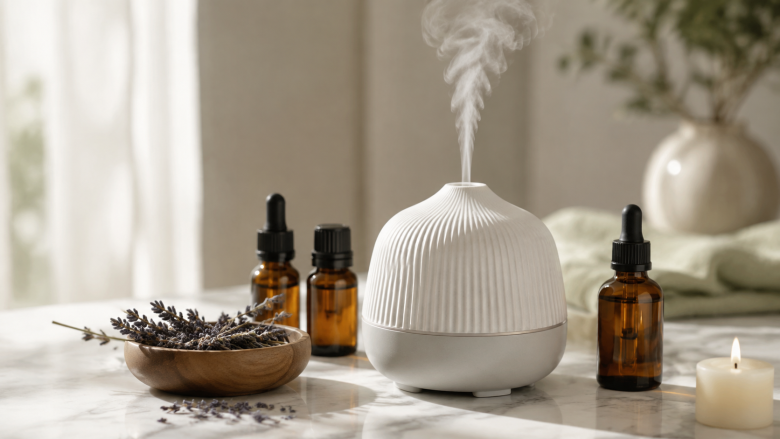
The most effective long-term aromatherapy protocol I have found is a 30-minute diffuser session about an hour before bed. This is not just about the scent. It is about the behavioral anchor: you are creating a consistent cue that tells your nervous system that the day is over. As we covered in our guide to simple home tips to reduce everyday stress, environmental cues matter more than most people think.
Building the Nightly Ritual
- Choose a diffuser that uses ultrasonic technology rather than heat. Heat can degrade the therapeutic compounds in essential oils. Ultrasonic diffusers disperse a fine mist without heat, preserving the plant chemistry.
- Use 3 to 5 drops of essential oil per 100 milliliters of water. More than that does not make it more effective; it just wastes oil and can irritate your airways.
- Run the diffuser for 30 minutes, not all night. Continuous exposure can dull your olfactory response and may cause headaches. Thirty minutes is enough to saturate the room with a therapeutic concentration.
- Place the diffuser on a stable surface at least three feet away from your bed. You want the scent to reach you, not a blast of moist air directly on your face.
For the nightly ritual, I recommend a synergistic blend rather than a single oil. Synergistic blending is the practice of combining oils that enhance each other's effects. This is one area where most competitor articles fall short - they list single oils, but they do not teach you how to combine them.
Three Nightly Diffuser Blends
Blend 1: The Classic Calm - 2 drops lavender, 2 drops sweet orange, 1 drop Roman chamomile. This is gentle, floral, and slightly citrusy. It works well for people who feel wired but tired.
Blend 2: The Grounding Woods - 2 drops cedarwood, 2 drops vetiver, 1 drop frankincense. This blend is earthy and resinous. It is better for people whose stress manifests as racing thoughts. Vetiver is thick and can be hard to measure; if it does not pour easily, hold the bottle upside down and let gravity do the work.
Blend 3: The Citrus Uplift - 2 drops sweet orange, 2 drops bergamot, 1 drop ylang-ylang. This is for stress that comes with low mood or heaviness. Bergamot adds a sophisticated citrus note, and ylang-ylang is a natural sedative. For skin application, skip the bergamot or use bergamot FCF (bergapten-free) to avoid phototoxicity.
The Thing Nobody Tells You About Diffusers
Cleaning your diffuser matters more than the oil you put in it. If you do not clean it regularly, mold and bacteria can grow in the water reservoir, and you will be diffusing those microbes into your bedroom air. I once went two weeks without cleaning my diffuser and noticed a musty smell. When I opened it, there was a thin biofilm inside. Now I clean it after every three uses with a 50/50 mix of white vinegar and water.
Also, do not use citrus oils in a plastic diffuser. Citrus oils are solvents and can degrade plastic over time, releasing microplastics into the mist. Use a glass or ceramic diffuser if you plan to diffuse citrus oils regularly.
Synergistic Blending: How to Combine Oils for Stress Relief
Blending essential oils is both art and science. The art is in the scent profile. The science is in the chemistry. Some compounds work together to enhance calming effects, while others can cancel each other out or create an unpleasant smell.
If you are new to blending, start with a simple framework: one base note, one middle note, and one top note. Base notes are heavy and grounding, like vetiver, cedarwood, and sandalwood. Middle notes are the heart of the blend, like lavender, chamomile, and ylang-ylang. Top notes are light and evaporate quickly, like sweet orange, bergamot, and lemon.
A balanced blend uses roughly 1 part top note, 2 parts middle note, and 1 part base note. For example, Blend 2 above uses 2 drops cedarwood (base), 2 drops vetiver (base), and 1 drop frankincense (middle). You can adjust ratios to suit your personal preference, but this framework prevents the common beginner mistake of making a blend that smells like one oil dominates everything.
Advanced Blending Considerations
Most people do not realize that the quality of essential oils varies dramatically between brands. A cheap lavender oil from a discount store may be adulterated with synthetic linalool or diluted with a carrier oil. I have bought bottles that smelled more like soap than lavender. Look for oils that list the botanical name, the country of origin, the extraction method (steam distillation, cold pressing, CO2 extraction), and a batch number. Reputable brands like Aura Cacia, Plant Therapy, and Mountain Rose Herbs provide this information.
CO2-extracted oils are generally higher quality than steam-distilled oils for delicate plant materials like chamomile, because CO2 extraction preserves more of the volatile compounds. However, CO2 oils are more expensive. If budget is a concern, steam-distilled lavender is perfectly fine. The difference is noticeable but not dramatic for stress relief purposes.
Another advanced point: the chemical composition of lavender varies by chemotype. Lavandula angustifolia is the standard, but Lavandula latifolia (spike lavender) has a higher camphor content and is more stimulating, not calming. If you buy lavender and feel more alert instead of relaxed, check the botanical name. You may have bought spike lavender.
Essential Oils for Stress: A Detailed Breakdown
While the list of "stress-relieving oils" is long, only a handful have meaningful research behind them. Here is a practical breakdown of the oils I actually recommend, along with their limitations.
Lavender (Lavandula angustifolia)
Lavender is the most studied essential oil for anxiety and stress. Research has shown that lavender inhalation can reduce heart rate and improve mood in stressful situations. One of the most cited studies found that dental patients who inhaled lavender had lower anxiety scores than those who did not. A 2019 review in the journal Evidence-Based Complementary and Alternative Medicine summarized multiple studies supporting lavender's anxiolytic effects.
However, lavender is not a sedative in the pharmaceutical sense. It is more of a gentle nervous system balancer. If you are in severe distress, lavender alone may not be enough. Use it as part of a broader stress management plan, not as a replacement for professional care.
Bergamot (Citrus bergamia)
Bergamot is a citrus oil with a complex, floral-citrus scent. It has shown promise in reducing stress and improving mood in several small studies. The key safety issue is phototoxicity. Bergamot contains bergapten, which makes skin extremely sensitive to UV light. If you apply bergamot to your skin and then go outside, you can develop severe burns and hyperpigmentation.
For inhalation and diffusion, phototoxicity is not a concern. For skin application, either avoid bergamot entirely or use bergamot FCF (bergapten-free), which has the phototoxic compound removed. I recommend bergamot FCF if you plan to make a massage oil blend.
Roman Chamomile (Chamaemelum nobile)
Roman chamomile is gentle and apple-like in scent. It is particularly useful for stress that comes with irritability or physical tension. It is also one of the few oils that is safe enough for use with children, though you should still dilute properly and consult a pediatrician for children under two.
The downside is cost. Roman chamomile is expensive because it takes a large amount of plant material to produce a small amount of oil. A 5-milliliter bottle can cost anywhere from $15 to $30. For a budget-friendly alternative, use German chamomile (Matricaria recutita), which is deeper in scent and also calming, though it is more commonly used for inflammation.
Yuzu (Citrus junos)
Yuzu is a Japanese citrus fruit with a bright, complex aroma. A 2020 study from Osaka University found that inhaling yuzu essential oil reduced stress and improved mood in participants. It is a nice alternative to sweet orange if you want something more sophisticated.
Yuzu is harder to find and more expensive than orange. If you cannot find it, sweet orange or mandarin are acceptable substitutes. The chemical profile is similar enough for stress relief purposes.
Frankincense (Boswellia carterii)
Frankincense has been used in religious and spiritual practices for thousands of years. It has a woody, resinous scent that many people find grounding. Some research suggests it can slow breathing and reduce heart rate. It blends well with lavender and cedarwood.
Frankincense is one of the few oils that works well for both acute stress and long-term anxiety. I keep a rollerball of frankincense diluted to 3% in a carrier oil in my desk drawer for stressful workdays.
How to Apply Essential Oils Safely: Dilution Ratios, Skin Sensitivity, and Toxic Oils
This is the most important section of this guide, and it is the section that most competitor articles completely ignore. Essential oils are concentrated plant extracts. They are powerful chemicals, not gentle water. Misuse can cause chemical burns, respiratory irritation, hormonal disruption, and even poisoning.
Dilution Ratios for Skin Application
- General adult use: 2% dilution, which is 12 drops of essential oil per 30 milliliters (1 ounce) of carrier oil.
- Facial application: 0.5% to 1%, which is 3 to 6 drops per 30 milliliters.
- Pregnancy: 0.5% to 1%, and only with oils that are considered safe during pregnancy. Avoid clary sage, sage, rosemary, and juniper berry during pregnancy, especially in the first trimester.
- Children aged 2 to 6: 0.25% to 0.5%, which is 1 to 3 drops per 30 milliliters.
- Children under 2: do not use essential oils topically without explicit guidance from a pediatrician.
Carrier oils matter too. Fractionated coconut oil is the most common because it is light, odorless, and does not stain. Jojoba oil is closer to human sebum and absorbs well. Sweet almond oil is nourishing but nut-based, so it is not safe for people with nut allergies. Always do a patch test on your inner forearm before applying a new blend to a larger area.
How to Do a Patch Test
Apply a small amount of the diluted blend to a one-inch area on your inner forearm. Cover it with a bandage and leave it for 24 hours. If you see redness, itching, swelling, or develop a rash, wash the area with mild soap and water and do not use that blend. If nothing happens, the blend is probably safe for you.
I once skipped a patch test with a homemade blend that included cinnamon oil. I applied it to my neck before a long flight. Within 30 minutes, my neck was bright red and burning. Cinnamon oil is a strong skin sensitizer and should never be used on skin at high concentrations. I now keep cinnamon oil only for diffusing, and even then, I use it sparingly.
Oils to Avoid or Use with Extreme Caution
- Wintergreen: contains methyl salicylate, which is toxic in high doses. It can be fatal if ingested. Do not use it topically in high concentrations.
- Cinnamon bark: severe skin irritant and sensitizer. Use only in very low dilution (0.5% or less) or avoid entirely.
- Clove bud: can cause skin burns and mucous membrane irritation. Use in very low dilution.
- Peppermint: can cause a choking sensation in young children and may trigger breathing issues in infants. Avoid with children under 6.
- Eucalyptus: do not use near the face of infants and children under 10. It can cause respiratory distress.
- Tea tree: can cause skin irritation and is toxic if ingested. Never ingest tea tree oil.
Speaking of ingestion: never swallow essential oils. This is non-negotiable. Essential oils are not food grade, and ingesting them can cause severe gastrointestinal damage, liver and kidney toxicity, and death. Some companies sell food-grade oils or advertise internal use, but this practice is dangerous and not supported by mainstream aromatherapy organizations. If you want the benefits of lemon or peppermint in your water, use fresh fruit or culinary mint leaves, not essential oils.
Pregnancy and Essential Oils
If you are pregnant, the rules change. Your sense of smell is often heightened, which can make strong scents nauseating. More importantly, some essential oils can cross the placental barrier and affect the fetus. The safety data is limited, so the conservative approach is best.
Safe for diffusion during pregnancy: lavender (small amounts), sweet orange, mandarin, Roman chamomile, ylang-ylang (small amounts), and frankincense. Avoid during pregnancy: sage, clary sage, rosemary, juniper berry, basil, cinnamon, clove, and wintergreen. Do not use any essential oils in the first trimester unless you have discussed it with your healthcare provider.
Pets and Essential Oils
This is another gap most articles miss. Cats are especially vulnerable to essential oils because they lack the liver enzyme (UGT1A6) needed to metabolize many plant compounds. Phenol-containing oils like wintergreen, clove, and oregano are particularly dangerous. Even lavender and tea tree can cause toxicity in cats if used in high concentrations or applied to their skin.
If you have cats, do not diffuse essential oils in a closed room where they cannot escape. Use a diffuser in a room with the door open, and never apply essential oils directly to your pet. If your cat shows signs of drooling, lethargy, vomiting, or difficulty breathing, seek veterinary care immediately.
Dogs are less sensitive than cats, but they still have a much stronger sense of smell than humans. A concentration that smells pleasant to you can be overwhelming to a dog. Always give your dog an exit route from the room where you are diffusing. Stop diffusing if your dog sneezes, paws at its nose, or tries to leave.
Aromatherapy for Different Types of Stress: Acute Panic vs. Chronic Stress vs. Sleep
Not all stress is the same, and the aromatherapy protocol that works for one type may not work for another. This distinction is rarely made in beginner guides, but it is essential for getting results.
Acute Panic and High-Intensity Anxiety
Acute panic is a fight-or-flight response. Your heart is pounding, your breathing is shallow, and your mind is racing. In this state, you need quick, direct intervention. The 5-minute emergency protocol above is your best option. Use direct inhalation of lavender or sweet orange. Add a grounding element: close your eyes and focus on the scent. The combination of olfactory input and focused attention can help shift your nervous system out of panic mode.
If you are prone to panic attacks, keep a small glass bottle with a dropper cap filled with a 5% dilution of lavender in fractionated coconut oil in your bag. When you feel a panic wave coming, put one drop on your wrist, rub your wrists together, and cup them over your nose. This is more portable than a tissue and easier to use discreetly in public.
Chronic, Low-Grade Stress
Chronic stress is the background hum of daily life. It is not a sudden spike but a constant pressure. For this, you need daily, consistent aromatherapy rather than emergency intervention. The nightly diffuser ritual is the most effective approach. You can also use a personal inhaler (a small plastic tube with an absorbent wick) filled with a blend of 3 drops lavender, 2 drops sweet orange, and 1 drop frankincense. Carry it with you and inhale a few times during the day as a mini-reset.
In our 30-day plan to reduce everyday stress, we emphasize that consistency beats intensity. Aromatherapy works the same way. A 30-second inhalation three times a day is more effective than a single 20-minute session once a week.
Stress-Related Sleep Disturbances
Stress and sleep are deeply connected. When you are stressed, your cortisol levels stay elevated, which makes it hard to fall asleep and stay asleep. Aromatherapy can help break this cycle, but you need to use the right oils and the right method.
For sleep, lavender is the most evidence-backed oil. A 2015 systematic review in the Journal of Alternative and Complementary Medicine found that lavender inhalation had a positive effect on sleep quality in several studies. A 2% lavender dilution applied to the soles of your feet before bed is a common and effective protocol. The soles absorb oils well, and the ritual itself is calming.
You can also add a drop of lavender to your pillowcase, but do not pour it directly on the pillow. The liquid can irritate your skin and eyes. Instead, put a drop on a cotton ball and tuck it inside the pillowcase near a corner.
The Placebo Problem: What the Research Actually Says
Here is the honest truth: part of aromatherapy's effect is placebo. And that is not necessarily a bad thing. The placebo effect is a real, measurable physiological response. If inhaling lavender makes you feel calmer because you expect it to, you still feel calmer. The outcome is real.
However, if you are looking for aromatherapy to treat a diagnosed anxiety disorder or clinical depression, the evidence is not strong enough to rely on it alone. A 2019 meta-analysis of aromatherapy for anxiety in the Journal of Clinical Psychiatry found small to moderate effects, but the authors noted significant methodological limitations in the existing studies, including small sample sizes and difficulty blinding participants to scent.
The lack of FDA regulation is another critical issue. In the United States, the FDA does not approve essential oils for medical use. They are categorized as cosmetics or personal care products. This means there is no regulatory body verifying that a bottle labeled "lavender" actually contains pure lavender, or that the claimed therapeutic benefits are real. You have to be an informed consumer.
When Aromatherapy Is Not Enough
Aromatherapy is a complementary tool, not a treatment. If you experience any of the following, please seek professional help:
- You have panic attacks more than once a week.
- Your stress is causing chest pain, shortness of breath, or fainting.
- You have persistent insomnia that lasts more than four weeks.
- You feel hopeless, numb, or unable to enjoy things you used to enjoy.
- Your stress is interfering with work, relationships, or daily functioning.
If you are already in therapy or on medication for anxiety, aromatherapy can be a useful addition, but always tell your doctor about any complementary practices you are using. Some essential oils can interact with medications. For example, lavender and chamomile may enhance the sedative effects of benzodiazepines or sleep medications, which could cause excessive drowsiness.
How to Buy Essential Oils Without Getting Ripped Off
Essential oils are a multi-billion dollar industry, and the market is full of low-quality, adulterated, and counterfeit products. Here is how to avoid wasting your money.
What to Look For on the Label
- Botanical name: the label should list the full Latin name, such as Lavandula angustifolia. If it just says "lavender," it may be a blend of species or synthetic.
- Country of origin: this tells you where the plant was grown. Lavender from France and Bulgaria is generally considered higher quality, but good lavender is also grown in other regions.
- Extraction method: steam distillation for most oils, cold pressing for citrus peels, CO2 extraction for delicate plants. If the label does not say, contact the company.
- Batch number and expiration date: these indicate a company that tracks quality control.
- GC/MS test report: many reputable brands publish gas chromatography-mass spectrometry reports for each batch. This is a chemical analysis that verifies the oil's composition and detects adulteration. If a brand does not provide these reports, be cautious.
Red Flags to Avoid
- Bottles labeled "fragrance oil" or "perfume oil": these are synthetic and not suitable for aromatherapy.
- Extremely cheap prices: a 10-milliliter bottle of genuine lavender should cost at least $8 to $12. If it costs $3, it is almost certainly diluted or synthetic.
- Plastic bottles: essential oils are volatile and can degrade plastic. High-quality oils come in dark glass bottles, usually amber or cobalt blue.
- Claims that the oil "cures" any disease: this is illegal and a sign of an untrustworthy seller.
When I first started using essential oils, I bought a "lavender" oil from a discount retailer because it was half the price of the brand at my local health food store. It smelled like soap and gave me a headache. When I checked the label, it said "fragrance oil." I was not using lavender at all. That was a $10 lesson in reading labels.
Putting It All Together: A Simple Framework for Stress Relief with Aromatherapy
If you want a practical framework that you can start using today, here it is. This is the system I use and teach to friends and family.
The Aromatherapy Stress Relief Framework
- Identify your stress type: acute panic, chronic stress, or stress-related sleep disturbance. Your protocol depends on this.
- Choose your primary oil: lavender for general stress and sleep, sweet orange for irritability, bergamot FCF for low mood, frankincense for grounding, Roman chamomile for physical tension.
- Select your delivery method: direct inhalation for acute stress, a personal inhaler for mid-day stress, a diffuser for nightly ritual, a diluted roll-on for on-the-go relief.
- Respect safety: always dilute for skin use, never ingest, keep oils away from pets, and avoid known contraindications.
- Track your response: after two weeks, ask yourself if your stress levels have changed. If not, adjust the oil, the blend, or the delivery method. Aromatherapy is not one-size-fits-all.
For a deeper look at managing stress during the workday, see our article on 7 quick tips to de-stress during work hours. A personal inhaler with a stress-relief blend is one of the easiest ways to integrate aromatherapy into your desk routine.
Final Takeaway: Aromatherapy Is a Skill, Not a Pill
The most important thing I have learned from years of using and teaching aromatherapy is that it rewards patience and attention. A single diffuser session will not fix a lifetime of stress. But a daily practice, built on safe methods and realistic expectations, can genuinely change how your body responds to pressure.
Start small. Buy one high-quality bottle of lavender. Use the emergency protocol the next time you feel overwhelmed. Build the nightly diffuser ritual when you are ready. Track your results, adjust your blends, and pay attention to what your body tells you.
And when aromatherapy is not enough, do not hesitate to seek professional support. The goal is not to replace medicine or therapy with essential oils. The goal is to add another tool to your stress management toolbox - one that is safe, pleasant, and genuinely helpful when used correctly.
Remember: the best aromatherapy practice is the one you can sustain. Consistency, safety, and honest expectations matter more than any single oil or blend.