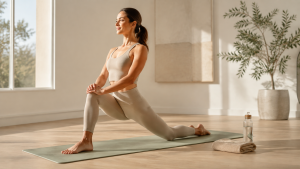
The answer to how to do gentle movement before bed is simple: you do it like a sensory wind-down, not a workout. You move just enough to release physical tension, but not so much that you raise your heart rate, engage your core, or stimulate your mind. The goal is to tell your nervous system that it's safe to sleep, not to improve your flexibility or burn energy. In this guide, I'll show you a protocol that works for insomnia, chronic pain, reflux, and restless legs, and I'll explain why most bedtime stretching routines fail.
Why Gentle Movement Works: The Nervous System Downshift
Most articles on bedtime stretching focus on muscle length. They list poses and tell you to breathe. But they rarely explain the actual mechanism that makes movement sleep-inducing. The key is not the stretch itself, it's the effect on your autonomic nervous system. Your nervous system has two main branches: the sympathetic (fight-or-flight) and the parasympathetic (rest-and-digest). When you lie in bed at night, your sympathetic system might still be active from the day's stress, keeping cortisol elevated and your heart rate slightly high. Gentle movement, done slowly and with awareness, stimulates the vagus nerve, which is the primary nerve of the parasympathetic system. This is called vagal tone. Higher vagal tone is associated with better sleep quality, according to research from the National Institute of Mental Health.
But there's another layer that most people miss: proprioception. Proprioception is your body's sense of where it is in space. When you move slowly and deliberately, you're giving your brain a stream of gentle, predictable sensory input. This input tells your brain that your body is safe and under control. It's the opposite of the chaotic, unpredictable input of a stressful day. By focusing on the feeling of movement, you shift your brain from a state of vigilance to a state of safety. That's why a simple body scan, where you just notice sensations, can be as effective as a full stretching routine.
Most people don't realize that the goal of bedtime movement is not to stretch muscles at all. It's to downshift your nervous system. If you approach it as "I need to loosen my hamstrings," you'll likely overdo it and wake yourself up. Instead, think of it as "I need to send a message to my brain that everything is okay." That shift in intention changes everything about how you move.
Key takeaway: Gentle movement before bed is a sensory protocol, not an exercise routine. It works by stimulating the vagus nerve and giving your brain predictable, safe sensory input.
The Sensory Wind-Down Protocol: A Step-by-Step Framework
Instead of giving you a random list of poses, I'm going to give you a framework. This is the protocol I've used for years with clients who struggle with falling asleep. It has five phases, and you can complete the whole thing in 10 to 15 minutes. The key is to move slowly enough that you can feel every millimeter of motion. If you feel rushed, you're doing it wrong.
Phase 1: The Body Scan (2 minutes)
Lie on your back in bed, or sit in a comfortable chair if you prefer. Close your eyes and take three slow breaths. Then, starting from your jaw, mentally scan down your body. Notice any areas of tension: your forehead, your shoulders, your stomach, your thighs. Don't try to change anything. Just notice. This is the foundation of the protocol because it tells your brain where to direct its attention. When I first tried this, I was shocked to discover how much tension I held in my jaw without realizing it. That awareness alone helped me relax.
Phase 2: Micro-Movements (3 minutes)
Now, instead of stretching, you're going to do tiny, almost imperceptible movements. These are called micro-movements. They're so small that they don't engage the muscles in a way that builds tension. For example, tilt your head slowly to the left, just a few degrees, then back to center. Repeat on the right. Do the same with your shoulders: lift them toward your ears by one centimeter, then release. The goal is not to reach a stretch. It's to lubricate the joints and send gentle signals to your nervous system. You can do these micro-movements for your neck, shoulders, hips, and ankles. The slower you go, the more effective they are.
Phase 3: Static Holds with Breath (5 minutes)
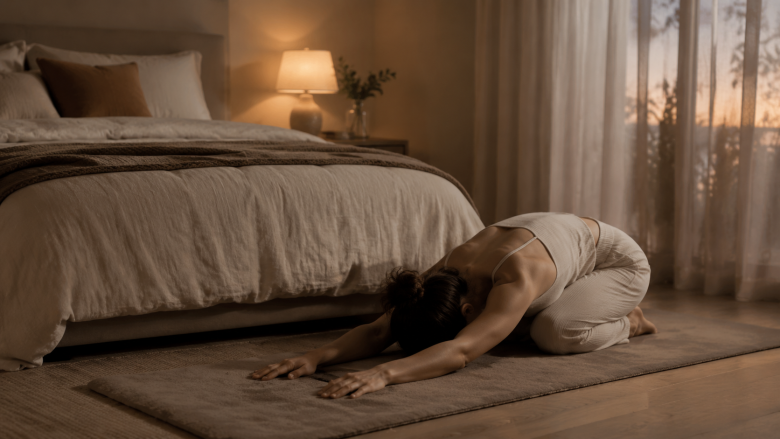
After you've done micro-movements, you can move into gentle static holds. But here's the crucial difference from regular stretching: you only go to about 30% of your range of motion, not 70% or 100%. For example, if you're doing a child's pose, you don't sink deep into the stretch. You rest in a position where you feel a mild, comfortable pull, and you stay there for 1 to 2 minutes while breathing slowly. The breath is the most important part. Aim for a 4-7-8 pattern: inhale for 4 seconds, hold for 7, exhale for 8. This exhale-dominant pattern activates the parasympathetic system.
One of the best static holds for sleep is legs-up-the-wall. Lie on your back with your legs resting vertically against a wall. This position is safe for most people and helps with circulation and lymphatic drainage. But if you have reflux, you need to modify it (see below). Another excellent hold is a supported child's pose, with a pillow under your chest. The key is to use props so you don't have to work to hold the position.
Phase 4: Rest and Observe (2 minutes)
After your static holds, lie flat on your back or on your side, whichever is comfortable. Close your eyes and just breathe normally. Notice any residual sensations in your body. You might feel a tingling or a warmth. This is the body's way of settling. Don't try to force relaxation. Just observe. This phase is often skipped, but it's essential because it gives your nervous system time to integrate the movement.
Phase 5: Transition to Sleep (1 minute)
Finally, when you're ready to sleep, roll onto your preferred sleeping position. If you're a back sleeper, stay as you are. If you're a side sleeper, draw your knees up slightly. If you need to get up to turn off a light or adjust a pillow, do it slowly. The goal is to maintain the calm state you've built. If you jump out of bed and start rushing, you'll undo everything. I recommend keeping a dim light next to your bed so you don't have to turn on a bright overhead light.
Here's a quick checklist you can use:
- Start with a body scan, not a stretch.
- Do micro-movements for 3 minutes.
- Choose 2-3 static holds, each for 1-2 minutes, at 30% effort.
- Breathe with a 4-7-8 pattern throughout.
- Rest and observe for 2 minutes.
- Transition to sleep without rushing.
How to Not Wake Yourself Up: Common Mistakes to Avoid
When I first started doing bedtime movement, I made the mistake of treating it like a mini yoga class. I did a full sun salutation, held each stretch for 30 seconds, and pushed into discomfort. The result? I was wide awake for two hours. Here's what I learned: the most common reason bedtime movement fails is that people accidentally stimulate their sympathetic nervous system. Here are the specific mistakes you need to avoid.
1. Over-stretching
Pushing a stretch to the point of discomfort triggers a reflex called the stretch reflex. This reflex activates muscle spindles, which send a signal to your spinal cord to contract the muscle. This is a protective mechanism, and it increases sympathetic arousal. So when you stretch too hard, you're literally telling your body to be on alert. Keep all stretches at a 3 out of 10 intensity, where 10 is maximum effort. You should feel a gentle pull, not a sharp sensation.
2. Engaging Your Core
Many people unconsciously tighten their abdominal muscles when they move, even during gentle stretches. If you're doing a lying twist or a forward fold, you might brace your core to maintain balance. That's a subtle but powerful signal of alertness. Before each movement, check in with your belly. It should be soft and relaxed. If you find yourself clenching, take a breath and consciously release your abdominal muscles.
3. Using Bright Lights or Screens
I don't need to tell you that blue light disrupts sleep, but even a dim phone screen can be problematic if you're checking it between stretches. The act of reading a notification shifts your attention from internal sensation to external stimulus, which raises arousal. If you need music, keep it instrumental and low volume, or better yet, use no music and focus on the sound of your breath.
4. Moving Too Fast
If you're doing a routine in 5 minutes that was designed for 15, you're rushing. The speed of your movement directly affects your nervous system. Slow, deliberate movements signal safety. Fast, jerky movements signal urgency. I recommend timing yourself with a gentle alarm or just moving at a pace where you can feel every tiny change in your joint position. If you find yourself speeding up, pause and take a breath.
5. Doing Too Many Repetitions
Even gentle movements can become stimulating if you do too many. The protocol I described has a total of about 10 minutes of actual movement. If you're doing 20 repetitions of each micro-movement, you're probably overdoing it. The goal is quality over quantity. Five slow neck rolls are more effective than twenty fast ones.
If you've been doing bedtime stretching and finding it doesn't help, these mistakes are likely the culprit. The fix is not to stretch more, but to stretch less, slower, and softer.
Adapting Gentle Movement for Specific Conditions
Most bedtime stretching guides assume you're a healthy, pain-free person. But many people struggle with sleep because of chronic pain, nighttime reflux, or restless legs syndrome (RLS). Here's how to modify the protocol for each.
For Chronic Pain
If you have chronic pain, especially in your back or joints, the last thing you want is to force a stretch. Instead, focus on micro-movements and body scanning without any static holds that might aggravate the area. For example, if you have lower back pain, avoid lying on your back with legs extended. Instead, lie on your side with a pillow between your knees. Do gentle knee-to-chest pulls, but only to the point of comfort. The key is to move within a pain-free range. You can also use a foam roller or a tennis ball to do self-myofascial release, but that's more intense than the protocol I'm describing. If you're in a flare-up, skip the movement altogether and just do the body scan. For a deeper look at using yoga poses for tension release, see our guide on gentle yoga poses for tension release.
For Nighttime Reflux (GERD)
Reflux is often worse when you lie flat. So you need to modify your positions. Instead of legs-up-the-wall, which requires lying flat, you can do a seated forward fold with a stack of pillows under your chest. Or you can lie on your left side with your upper body elevated on a wedge pillow. The key is to avoid any position where your head is lower than your stomach. That means no inverted poses like shoulder stand or legs up the wall with your hips elevated. You can still do neck rolls and shoulder micro-movements. For static holds, choose a seated cat-cow, where you sit on the edge of the bed and move your spine gently, keeping your torso upright. Also, wait at least 30 minutes after eating before you start your routine.
For Restless Legs Syndrome (RLS)
RLS is characterized by an irresistible urge to move your legs, often worse at night. Gentle movement can actually help, but you need to be careful not to overstimulate. Instead of static stretches, which can sometimes trigger the urge, focus on sustained, rhythmic movements like slow ankle pumps, knee bends, or leg slides on the bed. Some people find that compression stockings or a weighted blanket help, but movement can be effective. The key is to move your legs in a repetitive, predictable way, like you're slowly pedaling a bicycle. Do this for 5-10 minutes, then rest. If the urge persists, you may need to talk to your doctor about iron deficiency or other causes. For a more detailed protocol, consult a sleep specialist.
What to Do When You're Too Tired, Anxious, or Sore
There will be nights when even the thought of moving feels overwhelming. You're exhausted, your mind is racing, or your body aches. Here's how to adjust the protocol based on your state.
If You're Too Tired
If you can barely keep your eyes open, don't force yourself to move. The body scan alone is enough. Lie in bed, close your eyes, and just breathe. You can do a shortened version: scan from your head to your toes, and when you notice tension, imagine it melting away. This takes 2 minutes. If you fall asleep during the scan, that's perfect. The goal is sleep, not completion of a routine.
If You're Anxious
Anxiety often manifests as a racing heart and racing thoughts. In this case, you need to focus on exhale-dominant breathing. Start with the 4-7-8 pattern, and do it even before you begin any movement. Then, do only micro-movements, skipping static holds, because holding a pose can feel confining when you're anxious. The key is to use movement as a way to anchor your attention to your body, not to your thoughts. For example, as you do a neck roll, count the breaths. This gives your mind a single point of focus. If you feel a surge of anxiety, stop moving and just breathe. It's better to do 2 minutes of breath work than 10 minutes of movement that leaves you more agitated.
If You're Sore from Exercise or a Long Day
If your muscles are already fatigued, you don't need to stretch them. In fact, stretching sore muscles can delay recovery. Instead, do micro-movements that promote blood flow without pulling on the tissue. For example, gently circle your wrists and ankles, and do a few slow shoulder rolls. The goal is to increase circulation and reduce stiffness, not to elongate muscles. You can also use a warm bath or a heating pad before bed. The protocol is flexible enough that you can skip static holds entirely and just do the body scan and micro-movements.
A Simple 10-Minute Bedtime Routine You Can Start Tonight
Here's a concrete routine that incorporates everything I've described. It's designed to be done in bed or on a yoga mat next to your bed. Use a pillow and a rolled-up towel as props.
- Start with a body scan (2 minutes): Lie on your back, knees bent, feet flat on the bed. Place one hand on your belly and one on your chest. Breathe slowly. Notice any tightness in your jaw, shoulders, or lower back.
- Micro-movements for the neck (1 minute): Slowly tilt your head to the left, back to center, then to the right. Repeat 3 times each side. Then, turn your head to look over your left shoulder, then right. Keep the movement tiny.
- Micro-movements for the shoulders (1 minute): Gently roll your shoulders forward in a circular motion, then backward. Do 3 rolls each direction. Then, shrug your shoulders toward your ears and slowly release.
- Static hold: Supported child's pose (2 minutes): From a kneeling position, sit back on your heels. Place a pillow in front of you and rest your chest on the pillow. Your arms can be folded under your forehead. Breathe with a 4-7-8 pattern for 2 minutes. If this is uncomfortable, skip it.
- Static hold: Legs-up-the-wall (3 minutes): Lie on your back and swing your legs up against a wall. Place a folded towel under your hips for support. Keep your arms by your sides. Breathe deeply. If you have reflux, modify this by sitting on the floor with your legs extended and your back against the wall, but keep your head elevated with a pillow.
- Rest and observe (1 minute): Lower your legs and lie flat on your back. Notice how your body feels. Allow your breath to return to its natural rhythm.
- Transition: Roll onto your side and get comfortable. If you need to adjust your pillow, do it slowly.
This routine is a starting point. Feel free to swap in other static holds like a gentle spinal twist or a supported butterfly pose, but remember to keep everything at 30% effort. The goal is not to feel a deep stretch, but to feel a sense of release.
When to Skip It and Just Go to Sleep
There's a common misconception that you must do a bedtime routine every night. But the truth is, sometimes the best thing you can do is go straight to bed. If you're so exhausted that you can't focus on your breath, or if you're in so much pain that any movement worsens it, skip the routine. The protocol is a tool, not a mandate. You can always do it the next night. I've had nights where I intended to do a 10-minute routine, but I fell asleep during the first body scan. That's a win. The ultimate goal is sleep. If movement helps, great. If it doesn't, don't force it. Your body knows what it needs.
The thing nobody tells you about bedtime movement is that it's not about doing it perfectly. It's about showing up with curiosity and letting your body guide you. Some nights you'll feel a deep release. Other nights you'll feel nothing. Both are okay. Over time, you'll develop a sense of what your body needs before sleep, and you'll be able to adapt on the fly.
If you want to explore more specific poses for tension release, check out our detailed guide on gentle yoga poses for tension release. It covers a range of poses that you can integrate into your bedtime routine, always with the same principle: move slowly, breathe deeply, and never force.
Remember, the key to gentle movement before bed is not what you do, but how you do it. Slow, small, and soft. That's the message your body needs to hear to let go of the day and welcome sleep.