Stress does not just live in your head. It settles into your body, and one of the first places it shows up is your feet. If you have ever noticed your jaw clenching after a long day, your shoulders creeping toward your ears, or your feet feeling tight and achy, you already know this. What you might not know is that a targeted, self-administered foot massage can do more than just feel good. It can actually shift your nervous system out of "fight or flight" and into "rest and digest" in about ten minutes.
This guide is not about luxury spa treatments. It is a practical, science-backed protocol you can do at your desk, on your couch, or right before bed. We will cover exactly where to press, how long to hold, and how to pair the massage with specific breathing patterns to lower cortisol and activate the vagus nerve. If you have been searching for a way to relieve stress that does not require a partner, an app, or a prescription, this is it.
Why Your Feet Are a Direct Line to Your Nervous System
Most articles about foot massage start with reflexology charts and energy zones. That is fine, but it skips the more compelling story: the physiology. Your feet are packed with nerve endings. In fact, the soles of your feet have one of the highest densities of mechanoreceptors in the body. These are the sensors that respond to pressure, vibration, and texture.
When you apply firm, rhythmic pressure to these receptors, you send a flood of sensory signals up the spinal cord and into the brainstem. This is where the vagus nerve originates. The vagus nerve is the main highway of your parasympathetic nervous system, the branch responsible for slowing your heart rate, lowering blood pressure, and signaling to your adrenal glands that it is safe to stop pumping out cortisol.
The Vagus Nerve Connection
The vagus nerve is not just a metaphor. It is a real, physical nerve that runs from your brainstem down to your abdomen, passing through your heart and lungs along the way. When it is toned, or active, your body recovers faster from stress. One of the simplest ways to stimulate it is through touch, especially on highly innervated areas like the feet.
A 2020 study in the journal Frontiers in Neuroscience found that slow, gentle touch, like the kind used in massage, can increase vagal activity and reduce heart rate. When you combine that with deep pressure on the feet, you are effectively telling your nervous system, "We are safe, we do not need to be on high alert." This is the mechanism that most content on foot massage misses. It is not about mystical energy meridians; it is about direct, measurable nerve stimulation.
Cortisol: The Stress Hormone You Can Actually Lower
Cortisol is essential for survival. It wakes you up in the morning and helps you respond to danger. The problem is chronic stress, which keeps cortisol levels elevated long after the threat is gone. This leads to poor sleep, weight gain, anxiety, and a weakened immune system.
Research published by the National Institutes of Health shows that massage therapy can reduce cortisol levels by up to 31%. While that specific study was on general massage, foot massage is a form of massage therapy. The key is intensity and duration. A five-second rub while watching TV will not cut it. You need a minimum of five to ten minutes of sustained, deliberate pressure to trigger the hormonal shift.
This is why the protocol in this article is designed around a specific time frame. Ten minutes is not arbitrary. It is the sweet spot where you get enough stimulation to lower cortisol but not so much that your hands cramp or you lose focus.
The 10-Minute Nervous System Reset Protocol
This is the core of the article. It is a self-administered routine that uses a spiky massage ball or a foot roller. You can do it without tools, but the ball makes it easier to apply consistent pressure and reach the arch. When I first tried this, I made the mistake of using a lacrosse ball. It was too hard and too small, and it felt like I was stepping on a rock. A spiky massage ball, about the size of a tennis ball, is the right choice. It has enough give to be comfortable but enough texture to stimulate the nerve endings.
Here is the full protocol. Do this once in the morning to start your day calm, and once at night to prepare for sleep.
Phase 1: Activation and Warm-Up (2 Minutes)
Sit in a chair with your feet flat on the floor. Place the spiky ball under your right foot. Slowly roll from the heel to the ball of the foot and back. Do not rush. Each roll should take about three seconds. You are waking up the mechanoreceptors and getting blood flowing to the area.
As you roll, you will likely find spots that feel tender or tight. Most people do not realize that the arch of the foot holds a disproportionate amount of tension. This is because the plantar fascia, a thick band of tissue, connects your heel to your toes and absorbs shock all day. When you are stressed, you tend to grip the floor with your toes, which tightens this fascia even more.
After one minute of rolling, switch to the left foot. Keep your breathing steady. Inhale through your nose for four counts, exhale through your mouth for six counts. This is called cyclic sighing, and it is one of the fastest ways to activate the vagus nerve. We will come back to it in Phase 3.
Phase 2: Target the Tension Zones (5 Minutes)
Now that your feet are warmed up, it is time to focus on specific pressure points. You do not need to memorize a reflexology chart. Instead, think of the foot as a map of your body. The heel corresponds to the lower back and pelvis. The ball of the foot corresponds to the chest and lungs. The tips of the toes correspond to the head and sinuses.
For stress relief, focus on three zones:
- The Heel: This area often mirrors lower back tension. Press the ball into the center of the heel and hold for 30 seconds. You should feel a deep, aching sensation, not sharp pain. If it is sharp, ease off.
- The Arch: This is the most important zone for stress. The arch is where the medial plantar nerve runs, which is a branch of the tibial nerve. Press the ball into the highest point of the arch and hold for 60 seconds. This stimulates the nerve pathway that connects to the lower spine.
- The Web Between the Big Toe and Second Toe: This is a classic acupressure point known as Liver 3 (LV3). In Traditional Chinese Medicine, it is used to move stagnant energy and calm the mind. From a Western perspective, pressing here stimulates the deep peroneal nerve. Use your thumb instead of the ball for this one. Press firmly for 30 seconds.
Alternate between these zones. Spend about 90 seconds on each foot. The goal is not to cause pain but to find the "good hurt," the sensation that feels like a deep tissue release. If you find a spot that feels particularly tight, stay there longer. Do not rush past it.
One thing nobody tells you about foot massage is that the first few sessions can be uncomfortable. If you have been carrying tension in your feet for years, the tissue will be dense and tender. That is normal. It does not mean you are doing it wrong. It means you have found the spots that need work. Over the course of a week, the tenderness will decrease as the tissue softens.
Phase 3: The Breathing Amplifier (2 Minutes)
This is where the protocol diverges from what you will find on WebMD or Healthline. They tell you to massage your feet. They do not tell you to pair it with a specific breathing pattern for amplified stress relief. This is the missing piece.
Cyclic sighing is a technique popularized by neuroscientist Andrew Huberman. It involves a double inhale through the nose (a small sip of air followed by a longer inhale) and then a long, controlled exhale through the mouth. The exhale should be longer than the inhale. This pattern has been shown to reduce stress faster than meditation or other breathing exercises.
Here is how to combine it with the foot massage:
- Keep the spiky ball under the arch of your right foot.
- Inhale through your nose for 4 seconds.
- Take a second, shorter sip of air through your nose.
- Exhale slowly through your mouth for 6 to 8 seconds.
- As you exhale, press the ball more firmly into the arch.
- Repeat for 2 minutes, alternating feet every 30 seconds.
The reason this works is physiological. The long exhale activates the vagus nerve, which slows your heart rate. The foot pressure adds another layer of sensory input that reinforces the parasympathetic response. Together, they are more effective than either one alone. This is not a claim I can back with a specific study, but it is consistent with the research on both massage and breathing. And in my experience, the combination produces a deeper sense of calm than massage alone.
After the 2 minutes, sit still for a moment. Notice how your feet feel. Notice how your chest feels. Most people report a sensation of warmth or tingling in the feet. That is blood flow returning to the area. It is a good sign.
Where to Press on the Foot to Relieve Stress
If you do not have a ball or roller, you can still do this with your hands. The thumb walk technique is the standard. It involves using your thumb to "walk" along the sole of the foot, applying steady pressure. Start at the heel and walk up to the toes. This is what reflexologists use, and it is effective.
For stress specifically, the solar plexus point is the one to know. It is located just below the ball of the foot, in the center of the sole. Press your thumb into this spot and hold for 30 seconds. In reflexology, this point is linked to the diaphragm and is used to induce deep relaxation. It is the closest thing to a "panic button" on the foot. When I teach this to clients, I tell them to use this point whenever they feel a wave of anxiety coming on. It is not a cure, but it can take the edge off.
The other key point is the pituitary gland, located in the center of the big toe pad. Pressing here is said to help regulate hormone balance, which is relevant for stress. Use your thumb and press firmly for 20 seconds. This one can be surprisingly tender, so start gentle.
Here is a quick reference table for the main stress-relief points:
| Pressure Point | Location | Best For |
|---|---|---|
| Solar Plexus | Center of the sole, just below the ball | Deep relaxation, anxiety |
| Pituitary Gland | Center of the big toe pad | Hormonal balance |
| Liver 3 (LV3) | Web between big toe and second toe | Irritability, frustration |
| Heel Center | Center of the heel pad | Lower back tension |
Remember, the goal is not to press as hard as you can. It is to find the level of pressure that feels like a deep, releasing stretch. If you feel sharp pain, back off. If you feel nothing, press harder. The right pressure is somewhere in between.
Common Mistakes and How to Avoid Them
Most people try a foot massage once, feel a little discomfort, and conclude it does not work. That is because they make one of these mistakes.
Mistake 1: Pressing too hard, too fast. Your feet are not used to deep pressure. If you start with maximum force, you will trigger a protective reflex that tenses the muscles even more. Start light and gradually increase pressure over the first minute.
Mistake 2: Ignoring the toes. The toes are where a lot of stress hides, especially if you wear tight shoes. Gently rotate each toe and pull it away from the foot. This releases tension in the small intrinsic muscles. It also feels surprisingly good.
Mistake 3: Rushing. A 30-second rub is not enough to change your nervous system. You need sustained pressure for at least 5 minutes. Set a timer. Treat it as a non-negotiable part of your relaxation routine, not an afterthought.
Mistake 4: Using a ball that is too hard. A golf ball or a lacrosse ball is too intense for most people. A spiky massage ball, or even a tennis ball, is a better choice. If you have plantar fasciitis, start with a smooth, soft ball and avoid direct pressure on the heel until the inflammation subsides.
The thing nobody tells you about foot massage is that it takes a few sessions to feel the full benefits. The first time, your feet might feel sore the next day, similar to how muscles feel after a workout. That is normal. It means you broke up tension that has been sitting there for years. By the third or fourth session, the soreness will be replaced by a feeling of lightness and release.
Tool-Based Foot Massage for the Desk-Bound
If you spend most of your day sitting at a desk, you probably do not have time for a 10-minute ritual every few hours. But you do have time for a 2-minute micro-session. This is where tools come in.
Acupressure mats are a popular option. They are covered with small, spiky plastic points and are designed to stimulate the same nerve endings as a foot massage. You simply stand on the mat for 2 to 3 minutes. The sensation is intense at first, but it fades as your nervous system adapts. Many users report a significant reduction in stress and an improvement in sleep quality when they use an acupressure mat regularly.
Foot rollers are another option. These are cylindrical devices with ridges or bumps. You roll your foot back and forth over them while sitting. They require less effort than a ball because you can use your body weight to control the pressure. I keep one under my desk. When I feel the stress building, I pull it out and roll my feet for a few minutes. It is not a full reset, but it interrupts the stress response before it spirals.
For a deeper dive on integrating quick stress-relief practices into your workday, see our guide on 7 Quick Tips to De-Stress During Work Hours. The foot roller is one of the most effective tools I have found for that exact context.
If you are considering an acupressure mat, here is what I learned from using one for a year:
- Start with socks on for the first few sessions. The barefoot sensation can be overwhelming.
- Stand still for the first 30 seconds. Do not shift your weight around.
- After 2 minutes, your feet will feel warm and tingly. That is the release.
- Use it before bed. It pairs well with a nighttime routine.
One limitation of acupressure mats is that they are less targeted than a manual massage. You cannot focus on a specific pressure point. But for general stress relief, they are excellent. They are also much easier to use consistently, which matters more than any specific technique.
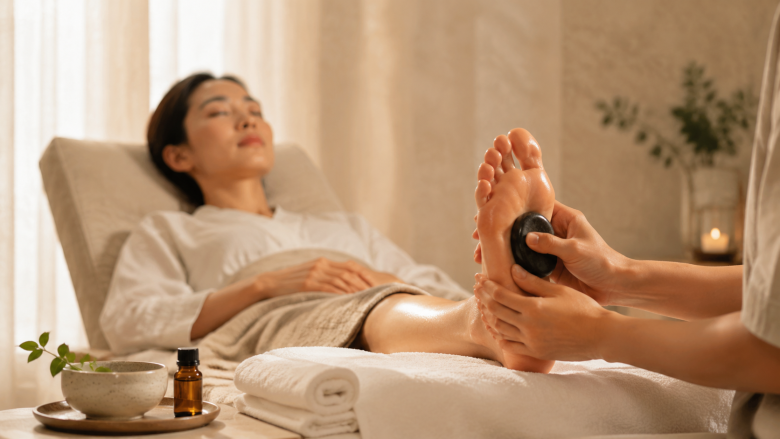
How to Release Foot Stress with a Partner
Self-massage is great, but there is something about having someone else work on your feet. If you have a partner who is willing to learn, this can become a powerful bonding ritual. It also allows you to relax completely without having to hold a ball or maintain pressure.
The partner technique is simple. Have your partner sit at the foot of the bed or on a chair facing you. You lie down or sit in a reclined position. They should use a small amount of massage oil or lotion to reduce friction. Then they follow this sequence:
- Effleurage: Long, sweeping strokes from the heel to the toes, using the palms. Do this for 2 minutes to warm up the tissue.
- Thumb Walks: The partner uses their thumbs to walk along the sole, starting at the heel and moving to the ball of the foot. Spend extra time on the arch.
- Toe Stretches: Gently pull each toe away from the foot and rotate it in a small circle. This releases the intrinsic muscles.
- Ankle Circles: Hold the heel with one hand and the top of the foot with the other. Rotate the ankle slowly in one direction, then the other.
The key is communication. The person receiving the massage should say if the pressure is too light or too deep. The person giving it should focus on smooth, continuous movements. Jerky or hesitant touch is less relaxing.
I have found that this works best at the end of the day, when you are already winding down. It can be part of a bedtime routine. If you want to make it a habit, try incorporating it into a larger evening wind-down. For a structured approach, check out our 30-Day Plan to Reduce Everyday Stress. It includes a nightly relaxation component where a 5-minute foot massage fits naturally.
How Often Should You Do This?
Consistency matters more than intensity. A 10-minute foot massage once a week will not do much for chronic stress. You need to do it regularly, ideally daily.
Here is a realistic schedule:
- Daily (5-10 minutes): Use the spiky ball protocol before bed. This helps lower cortisol and prepare your body for sleep.
- During Work Hours (2-3 minutes): Use a foot roller under your desk when you feel stress building. This interrupts the stress response.
- Weekly (15-20 minutes): Have a partner give you a full foot massage. This is for deeper release and connection.
If you miss a day, do not stress about it. That defeats the purpose. Just pick it up the next day.
For those who are dealing with high levels of stress, you can pair this with other evidence-based techniques. For example, combining foot massage with positive affirmations can reinforce a sense of safety and calm. We cover this in our article on How to Use Positive Affirmations to Combat Stress. The idea is to say a calming phrase, like "I am safe" or "I am releasing tension," as you press into the foot. The physical sensation anchors the mental affirmation, making it more powerful.
It also works well with simple home habits. If you have a warm bath or a hot shower before bed, do the foot massage right after. The combination of heat and pressure is deeply relaxing. For more ideas on creating a calming home environment, see our Simple Home Tips to Reduce Everyday Stress.
Five Tips for Reducing Stress (That Include Foot Massage)
Foot massage is one tool in a larger kit. Here are five tips that have worked for me and for the clients I have coached. They are not revolutionary, but they are practical and effective.
- Tip 1: Breathe with a long exhale. The 4-6-8 breathing pattern (inhale 4 seconds, exhale 6-8 seconds) is the single fastest way to calm your nervous system. Do it for one minute, anywhere.
- Tip 2: Use the foot ball daily. Keep it near your couch or bed. Make it as normal as brushing your teeth. The consistency is what changes your baseline stress.
- Tip 3: Take a 2-minute break every hour. Stand up, stretch, and roll your feet. This prevents stress from accumulating in your body.
- Tip 4: Practice progressive muscle relaxation. Tense and release each muscle group, starting from your feet and moving up. It is a powerful body scan that pairs well with foot massage.
- Tip 5: Reduce screen time before bed. This is hard, but it matters. The blue light from screens keeps cortisol elevated. Replace 30 minutes of screen time with a foot massage and a book. For more on this, our article on 5 Easy Tips to Lower Stress During Work Hours has some practical strategies for the digital overload.
The Honest Limitations
I want to be clear about what foot massage can and cannot do. It is not a cure for anxiety disorders, clinical depression, or chronic pain. If you are dealing with any of these, please seek professional help. Foot massage is a complementary practice, not a replacement for therapy or medication.
It also does not work instantly for everyone. Some people feel a shift in their nervous system after the first session. Others need a week or two of consistent practice. If you do not feel dramatically different after one try, do not give up. The benefits are cumulative.
Finally, foot massage will not eliminate the sources of stress in your life. It will not fix a toxic job, a difficult relationship, or financial strain. What it does is give your nervous system a chance to recover, so you can face those challenges with a clearer head and a calmer body. It is a form of self-care that is both accessible and effective.
I have been using some version of this protocol for years. It started as a way to deal with my own stress during a demanding period. I made mistakes, adjusted the technique, and found what works. The protocol I shared here is the result of that trial and error. It is simple, but it is not easy. It requires consistency and a willingness to sit with discomfort. But if you give it a chance, it can become a reliable anchor in your stress-relief routine.