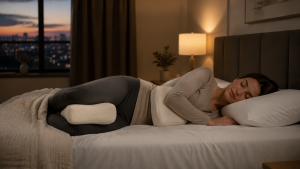
The Real Reason Your Brain Spins Up Tomorrow's Worries at Night
You've been there: it's 11:42 PM, your body is exhausted, but your brain is running a full production of tomorrow's worst-case scenarios. You're not just rehashing the past - you're trying to solve a problem that hasn't happened yet. That's anticipatory anxiety, and it's a completely different beast from general stress.
Here's the short answer to the question you actually came here with: to fall asleep when anxious about tomorrow, you need to contain tomorrow's thoughts in a structured way that tells your brain, "I've got this handled." The 3-step ritual I use with my clients is built on this: brain dump + one priority, a 10-minute worry window, and imagery rehearsal.
When I first started coaching people with evening anxiety, I made the mistake of assuming they needed more elaborate wind-down routines. The opposite was true. They needed a system that worked even when they were so anxious they couldn't remember their own names.
Most people don't realize that the worst thing you can do is try to stop worrying. The more you suppress a thought, the louder it gets. The solution is not to silence your worry - it's to give it a time and place, then put it aside.
Why "Just Calm Down" Makes It Worse: The Science of Anticipatory Anxiety
Anticipatory anxiety is your brain's way of trying to protect you from a future threat. It's the same mechanism that kept your ancestors alive when they heard rustling in the bushes - except now, the "bush" is tomorrow's presentation, exam, meeting, or difficult conversation.
Your brain doesn't know the difference between a real threat and an imagined one. When you lie in bed thinking about tomorrow's big event, your amygdala goes into overdrive, releasing cortisol and adrenaline. These stress hormones keep you awake because your brain thinks you need to be alert to survive.
What causes panic attacks when trying to fall asleep? In many cases, it's the brain-body loop of anxiety. You notice you're not sleeping, you get anxious about not sleeping, which raises your heart rate, which makes falling asleep even harder. This is called a spiral, and it's often the trigger for full-blown nocturnal panic attacks, which affect an estimated 5% of the population, according to the National Institute of Mental Health.
This is why generic sleep hygiene advice - "avoid screens," "cut the caffeine," "try chamomile tea" - falls flat. You don't need more sleep hygiene. You need a protocol for handling tomorrow's mental load.
Here's what nobody tells you: the goal isn't to stop worrying. The goal is to worry in a way that doesn't ruin your sleep.
The 3-Step "Close the Mental Tabs" Ritual
Think of your brain like a web browser with 47 tabs open. Each tab is a task, a worry, or a decision for tomorrow. The most effective way to get a night of restful sleep is to close those tabs - not by ignoring them, but by acknowledging them and putting them somewhere you can find them in the morning.
Here's the ritual. It takes about 15 minutes, start to finish.
Step 1: The Brain Dump and One-Priority Rule
Get a physical notebook and a pen. Not your phone, not your laptop - a physical notebook. The act of writing by hand engages your brain differently than typing, which is why this works. Let me be clear: this is not the same as journaling. You're not processing feelings. You're offloading tasks.
Write down everything that's on your mind about tomorrow. Every single thing. The presentation at 9 AM, the email you need to send to your boss, the groceries you need to buy, the phone call you've been dreading. Don't filter, don't organize, just dump.
Now, here's the part most people get wrong: don't try to solve any of these problems tonight. The goal is to get them out of your head, not to take action.
When you're done, circle the one thing that absolutely must happen tomorrow. Not the most important thing - the most urgent thing. This is your "one priority" for tomorrow. Write it at the top of a fresh page.
Why this works: your brain's working memory can only hold about 4 items at once (research by Cowan puts it at 4 +/- 1). When you offload your to-do list onto paper, you free up mental bandwidth. When you pick a single priority, you're giving your brain permission to stop thinking about the other 15 items.
Step 2: The 10-Minute Worry Window
Here's the thing that surprises people: I'm not going to tell you to stop worrying. That's impossible. What I will tell you is to schedule your worry.
Set aside 10 minutes earlier in the evening - say, 7 PM or 7:30 PM - as your "worry window." During this time, you're allowed to worry about absolutely anything you want. Write down every concern, every "what if," every worst-case scenario. Get it all out.
Here's the catch: once the 10 minutes are up, you're done. You're not allowed to worry about anything else for the rest of the night. If a worry tries to break into your head at 10 PM, you tell it, "Sorry, I'm not accepting new worries right now. I'll see you tomorrow at 7 PM."
Now, I'll be honest with you: this takes practice. The first few times, your brain will fight back. It will find new ways to raise the same old worries. That's normal. Just keep repeating the same phrase: "I'll see you tomorrow at 7 PM."
The key is to be consistent. Your brain learns by repetition. After a few nights of this, it starts to trust that you'll show up for the worry window, and it can let go of the anxiety during the night.
When I first started this practice, I made the mistake of skipping the worry window on nights when I wasn't feeling anxious. That was a mistake. The worry window works best when it's a routine - not just a reactive tool.
Step 3: Imagery Rehearsal
This is the step that most people skip, and it's the one that makes the biggest difference. Instead of trying to clear your mind (which, let's be honest, never works), you're going to use your imagination productively.
Once you're in bed with the lights off, close your eyes and mentally walk through tomorrow's first step. Not the whole day - just the first step. If you have a big presentation at 10 AM, you don't visualize the entire presentation. You visualize waking up, brushing your teeth, making coffee, and sitting down at your desk to review your slides.
Why does this work? Because it gives your brain a concrete, manageable task to focus on. Instead of trying to process an entire day's worth of potential disasters, you're giving it one small, achievable task. This reduces the cognitive load and makes it much easier to relax.
Here's an example. Let's say you have a job interview tomorrow at 2 PM. Your brain wants to catastrophize - "What if I forget my own name?" Instead of going there, you visualize yourself waking up, making coffee, having breakfast, and sitting down to review your notes. That's it. No further.
Most people don't realize that this technique, sometimes called mental rehearsal, is used by elite athletes to improve performance. It's not just a nap-time trick - it's a performance hack for your sleep.
Quick note: If you're using imagery rehearsal and you find yourself spiraling into worst-case scenarios, that's a sign that you're not ready for this step yet. Go back to the brain dump and make sure you've written down every single worry. The imagery rehearsal only works if you've fully offloaded the day.
What to Do When You Wake Up at 3 AM Anxious
So you've done the ritual, you've done your 10-minute worry window, you've tried the imagery rehearsal, and you're still wide awake at 3 AM with your heart racing. What now?
First, don't just lie there. I know you've heard the advice "stay in bed and rest" - and that's fine if it works for you. But for many people, lying in bed awake only makes the anxiety worse. You start to associate your bed with stress, which makes it harder to fall asleep.
Here's what I recommend: get out of bed, go to a dimly lit room, and do a 2-minute body scan meditation. Sit in a comfortable chair, close your eyes, and focus on your breath. Feel your feet on the floor, your back against the chair. If your mind wanders (it will), gently bring it back to your breath.
Why does this help? Because it breaks the cycle of anxiety. It tells your brain, "We're not in danger right now. We're just sitting here, breathing." It's a physiological reset.
Now, here's the part that might surprise you: if you've been in bed for more than 20 minutes and you're still wide awake, get up. Go to another room, do something boring (reading a book, folding laundry - anything that doesn't involve screens), and only go back to bed when you feel sleepy. This is called stimulus control therapy, and it's one of the most effective non-drug treatments for insomnia.
What if you're having a full-blown panic attack? I've been there. Your heart is racing, you can't catch your breath, and you're convinced you're dying. First, know that you're not. A panic attack is uncomfortable but not dangerous. It will pass. Find something to focus on - the feeling of your feet on the floor, the sound of your own breath - and ride the wave.
If you're having frequent panic attacks at night, it's worth talking to a professional. Cognitive behavioral therapy (CBT) is particularly effective for anxiety and sleep issues.
How to Calm Your Nervous System Right Now
Let's say you've done the ritual, you've tried the imagery, and you're still feeling keyed up. Here are a few other things that can help calm your nervous system in the moment:
- Physiological sigh: Take a deep breath in through your nose, then take another short sip of air, and exhale slowly through your mouth. Do this 3-5 times. This is a rapid way to activate your parasympathetic nervous system, according to research on breathing techniques.
- Cold water on your face: Splash cold water on your face, or hold an ice cube to your cheeks. This triggers the "mammalian dive reflex," which slows your heart rate.
- Progressive muscle relaxation: Tense and release each muscle group in your body, starting with your toes and working your way up. This is a well-studied relaxation technique that can help you fall asleep faster.
These are not cures - they're management strategies. They will help you get through tonight and tomorrow, but they won't make the anxiety disappear. That's okay. You're not broken. You're learning to live with an anxious brain, and that's a skill like any other.
One thing that often surprises people: the nervous system has a say in all of this. When you're anxious, your body is in "fight or flight" mode. Before you can fall asleep, you need to shift into "rest and digest" mode. That's why the physiological sigh and cold water work - they're direct signals to your body that the danger has passed.
When it comes to how to fall asleep quickly with anxiety, the answer is usually about slowing down your nervous system, not about finding a more comfortable pillow or the perfect amount of blankets.
The "I Can Handle It" Reframe: Decoupling Sleep from Performance
Here's a sneaky way anxiety keeps you up at night: by making you anxious about being anxious. "If I don't sleep well tonight, I'll be a zombie for tomorrow's big meeting." "If I don't get 8 hours, I'll make a mistake."
This is called sleep performance anxiety, and it's one of the most common forms of sleep-related anxiety I see. And it's a self-fulfilling prophecy - the more you worry about not sleeping, the harder it is to fall asleep.
The fix is to decouple your sleep from your performance. You are not your sleep. You can have a bad night of sleep and still nail your presentation. I've done it. You can too.
Here's a reframe that might help: "I don't have to be at my best tomorrow. I just have to be present." And honestly, even that's not entirely true - you just have to show up.
Another trick from CBT: practice cognitive defusion. Instead of saying "I am anxious," say "I'm having the thought that I'm anxious." It creates distance between you and the emotion, and it makes it easier to let go.
Here's a practical exercise: write down your worry on a piece of paper, then write down the opposite of that worry. For example, "I'm going to forget my whole presentation" becomes "I'm going to forget my whole presentation... and that would be embarrassing." Now ask yourself: is that really true? What's the evidence for and against each thought? This is a core technique in cognitive behavioral therapy, and it works because it forces your brain to engage in rational thinking, which is hard to do when you're panicking.
When to Talk to a Professional
This article is not a substitute for professional help. If you're having panic attacks every night, or if anxiety is significantly interfering with your daily life, please talk to a doctor or a mental health professional.
There's also a difference between anxiety and an anxiety disorder. According to the American Psychiatric Association, anxiety disorders are the most common mental health concern in the United States, affecting about 30% of adults at some point in their lives. You're not alone, and there is help.
The good news is that therapy, particularly cognitive behavioral therapy (CBT), is highly effective for anxiety. A therapist can teach you specific techniques for managing your anxiety, and they can help you get to the root of why you're so worried about tomorrow.
Here are some signs it's time to reach out to a professional:
- Your anxiety is keeping you from falling asleep more than 3 nights a week for over a month
- You're having panic attacks that are getting more frequent or more intense
- You're experiencing physical symptoms like a racing heart, chest pain, or shortness of breath that you can't explain
- You're using alcohol or other substances to fall asleep
- Your sleep issues are affecting your relationships, work, or school
The Bottom Line
Falling asleep when anxious about tomorrow isn't about being a perfect sleeper. It's about managing your tomorrow-brain so it doesn't hijack your tonight-brain. The 3-step ritual - brain dump + one priority, the 10-minute worry window, and imagery rehearsal - gives you a concrete way to do that.
Be patient with yourself. This isn't about being "good" at sleeping. It's about giving yourself permission to rest, even when your brain is screaming at you to be productive.
You've got this. Now close the laptop, turn off the light, and go close some mental tabs.